Spotting peat

For anyone who wants a relatively concise introduction to the Peat Spotter project I’ve been working on for the last year with Rezatec, funded by the European Space Agency, we’ve just published a promo video on YouTube.  I’ll aim to write a bit more about it soon for those avid peat spotters out there.  For now, prizes for those that spot my precious clubbed thumb in action.

IMG_2363

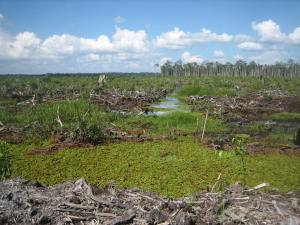
An area in Central Kalimantan where we trialled some of the equipment and protocols that we’ll use to spot peat, in the ‘field’.  Here we have a typical Southeast Asian scene of drained peat, with oil palms planted in the fore- and background, and a degrading fragment of forest off in the distance.  Whether that patch of trees can actually be called a forest is another thing.  


Contenders for the Darwin awards?

Imagine this: you work for the Northern Powergrid, replacing wooden electriticy poles across the Cumbrian landscape.  Your specific role is driving the big diggers – the power behind the project.  You’re wanting to get your digger across the valley to the pole-replacement ground in time to get back home for tea.  So why not take a short-cut across that 1000 acres of flattish area you see infront of you?

Because …. YOU’LL SINK!  That’s what happened when Digger #1 attempted to cross the Butterburn Flow (what a name!) upland peat bog back in September.  What’s more, it’s a Site of Special Scientific Interest (SSSI); there were fears that oil leakages and the general disturbance would threaten the ecosystem.  Cue Digger #2.

Two diggers are stuck in the bogImage credit: ITV Border.

Digger #2 went in after Digger #1 on a rescue mission, and guess what?  IT SUNK!  Two huge diggers stuck-in-the-mud.

According to reports, there was a retrieval plan involving a temporary metal road surface, probably more diggers and a lot more people.  So they are likely to be out now, but I doubt they made it home in time for tea.

Contenders for the Darwin Awards?

A plug for peat

Yesterday I entered into the International Union of Forest Research Organisations’ (IUFRO) blog competition.  In the build-up to their World Congress, starting on October 5th, IUFRO wanted people to post articles about their research and work involving “Sustaining Forests, Sustaining People – The Role of Research” – the theme of the congress.  Though I only managed to touch the surface of this issue in my entry, I wanted to make sure the challenging nature of tropical peat swamp forest conservation got some air-time.  If you’re interested, you can view it (and consider voting!) here.

Protecting PEAT

This is the first of many peat-related posts.  Towards the end of 2013, I was interviewed by Laura Bramley for her post on The Freshwater Blog – a great site that regularly publishes information of relevance to freshwater management, conservation and policy, as part of the European Union-funded MARS project.  Laura managed to eloquently transcribe my mumblings, to an extent that I had a much clearer outlook on my research and career direction after reading it.  I’m posting it here in case it provides a useful insight into why I’m so passionate about peat.  Thanks, Laura!

Exploring recovery rates in tropical forests

After one near-missed flight (trying to correct the proof in time for the deadline in an airport flying between islands whilst peat spotting in Indonesia), several near sleepless nights (correcting previous drafts) and three attempts to download free-trial software (for last minute figure alterations whilst >1000 miles away from a computer that had the software on)….I was relieved to have my first paper published earlier this year.  And excited to have Cole associated, in print, with tropical forests, at long last.  The paper describes some research I did as part of my PhD, exploring the rates of tropical forest recovery after different disturbance events in the past.  Many a fossil pollen diagram was trawled to collect the data and we found some interesting results of relevance to the debate on tropical forest resilience.

Back in June, I had the privilege of writing a post on this research and our findings for the Kew Science Blog and to make a cameo appearance on Phil Martin’s Ecology for a crowded planet website, so if  you’d like to read more about the work, have a click (one’s enough – bit of a cut-and-paste job!).  Soon after, to my delight, the great Professor Corey Bradshaw wrote a bit about the research on his ConservationBytes blog.

As a first exploration of the vast data stored in published palaeoecological studies of tropical forest ecosystems, I was pleased with the insights I gleaned, but there’s a lot more potential locked up in these fossil pollen datasets.  I’ve got a long list of questions ready to start researching….as soon as a philanthropist with a tropical forest leaning gets word of the opportunity!

Soon has come!

‘Soon’ being approximately nine months, apparently!  Now that the very summery sun we’ve been having in the UK is fading and blackberry season is nearly over, I plan on posting words here much more regularly.

Here’s a slightly outdated one for starters….