Power from peat in Rwanda

Last week, an article that I showcased on my blog a few months ago was published (re-vamped) in The Conversation.  Since it went live, I’ve had some very interesting comments and conversations about where and how we get our electricity.  What is the best source of power for a country?  What factors are considered in making that choice?  Which takes precedence over energy-efficiency, cost-effectiveness and environmental impact?  Is the latter even considered?  I am beginning to understand the complexity of issues involved in making choices between fossil fuels, renewables, national and international energy supplies, access and development.  But I have much still to learn.  It’s perhaps the biggest challenge of our time.  Whatever the answer though, power from peat is surely not a solution.

Rwanda adds to energy mix with first peat-fired power plant in Africa

Image 20170406 6397 rtc6o3
Rwanda’s first peat-fired power plant at Gishoma is currently running at 10.85MW.
Rwanda Energy Group/Twitter

Lydia Cole, University of Oxford

Rwanda recently celebrated the opening of its first peat-fired power plant at Gishoma in the far west of the country, a $39.2M project. It is the first of its kind in Africa. The Conversation

Another larger peat plant, costing $350M is under development in Gisagara to the east. The plan is for Gishoma to start feeding 15MW of electricity into the national grid imminently, and Gisagara 80MW by 2019.

The Rwandan government is hoping to achieve its goal of connecting 70% of the country’s 11.7 million people to the national grid by 2018. This is a near three-fold increase on the number connected at present. The peat-to-power plant at Gishoma will contribute to this goal, and further increase the installed capacity of the nation. This will reduce Rwanda’s reliance on expensive imports of diesel oil for power generation.

At the moment, only 25% of households have access to the 190MW of power generated in country. But over the next two years the capacity is projected to reach 563MW in line with national development goals. This increase will be made possible in part through the harnessing of power from peat.

Peat power

Peat provides an effective energy source when dried, comprising a minimum of 30% organic matter. It develops under anaerobic conditions, where waterlogging significantly slows or prevents the decomposition of dead vegetation. As the vegetation grows in the surface layers, it absorbs atmospheric carbon through the process of photosynthesis. When it dies, this carbon is stored in the accumulating substrate which is peat.

Peatlands are found across the world. But they are concentrated within certain regions where high humidity or low temperatures reduce the rate of decomposition. These include the coastal lowlands of southeast Asia or northern Russia’s permafrost zones. Despite covering just 3% of the world’s ice-free land surface, peatlands store up to 30% of its total soil carbon stock. This makes them the most efficient carbon storage facility we have.

But arguably, not a renewable one. Though each peatland varies, one centimetre depth of peat may take an average of 10 years to accumulate, and less than 10 minutes to burn.

Rwanda energy mix

Rwanda’s energy comes from a diverse mix of renewable sources. Hydro-power is the main contributor at 59%, followed by thermal (40%) and methane (1%). There are also ambitious plans for off-grid power from solar.

Peat power is considered one of these more sustainable indigenous sources of energy. It has the potential to contribute nearly 20% to the national energy supply in five years’ time.
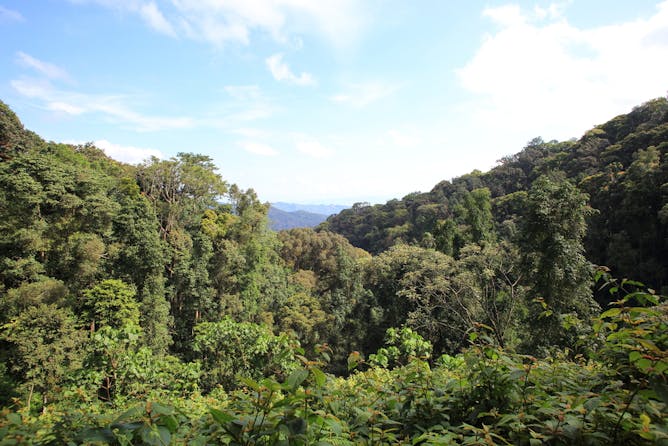
The Gishoma plant is nestled within the Nyungwe Forest National Park.
Shutterstock

It’s estimated that there will be sufficient peat deposits to power Rwanda for 30 years, or some proportion of the country at least. The enhanced power that will come from the Gishoma and Gisagara peat-to-power plants is seen as an important part of the country’s development provision.

The plans are enabled through financial support from the African Finance Corporation, the Development Bank of Rwanda and Finnfund, the Finnish Development Finance Company, among other lenders. Finland has expertise in peat extraction and its use in the energy industry, with an average of 5% of its national supply coming from peat. This was encouraged by subsidies until recently.

But where is Rwanda’s peat?

The Gishoma plant is nestled within the Nyungwe Forest National Park. This is an

untouched natural rainforest that is filled with exciting biodiversity.

The park’s website boasts of the presence of hundreds of species of trees and orchids within the park, such as the swamp-dwelling Eulophia horsfellii. It’s also host to numerous plants species of medicinal value, like the East African satinwood, Zanthoxylum gilletii, and to one of the last stable populations of chimpanzees in East Africa. But there is no mention of peat. It’s evidently not a key feature for the average tourist.

There are vast areas of peatlands across the Tropics that we are only now starting to map and understand their full extent and carbon content. For example, it was only a few months ago that the first map of the world’s largest tropical peat complex was published. Around 145,500 square kms of peat swamp forest was found in the central Congo Basin.

There may well be vast resources of peat in Rwanda that local residents have known about for years, or that the Finns have sniffed out recently, of which science has yet to be told or be concerned about. But whatever the scenario defining the nation’s peaty asset and wherever it is exactly, it is unlikely to be there for much longer if peat-to-power generation continues to be Rwanda’s cost competitive energy solution.

Given that it takes thousands of years to accumulate just hundreds of centimetres of peat, is peat-power really the solution to the nation’s energy needs? Can the Elon Musk’s out there create an energy-storage solution quickly enough that renewables make a serious contribution?

For now though, Rwanda is set to power through its peat.

Lydia Cole, Researcher Associate of the Department of Zoology; Environmental Scientist, Rezatec Ltd., University of Oxford

This article was originally published on The Conversation. Read the original article.

Happy World Wetlands Day!

Today is a day to celebrate and spread the word about our world’s wonderful wetlands.

Borrowed from the World Wetlands Day website. (Thank you!)

On this day 46 years ago, the Convention on Wetlands was adopted in the Iranian city of Ramsar.  Since then, the 2nd February has marked the signing of this Ramsar Convention: “an international treaty that provides the framework for national action and international cooperation for the conservation and wise use of wetlands and their resources”.

Wetlands are increasingly acknowledged for their importance in controlling the quality and quantity of water flowing across landscapes, as reflected by the theme of this year’s World Wetlands Day: Wetlands for Disaster Risk Reduction.  They are also important for biodiversity conservation, for filtering pollutants from water supplies and of course our magnificent peatlands are critical for sequestering and storing atmospheric carbon (in their intact form).

Perhaps it’s time for a World Peatlands Day?

To celebrate the day and how peatland management has changed in the UK and Ireland over the last few generations, from predominantly extraction to conservation, here is a poem by Seamus Heaney:

Digging

Between my finger and my thumb   

The squat pen rests; snug as a gun.


Under my window, a clean rasping sound   

When the spade sinks into gravelly ground:   

My father, digging. I look down


Till his straining rump among the flowerbeds   

Bends low, comes up twenty years away   

Stooping in rhythm through potato drills   

Where he was digging.


The coarse boot nestled on the lug, the shaft   

Against the inside knee was levered firmly.

He rooted out tall tops, buried the bright edge deep

To scatter new potatoes that we picked,

Loving their cool hardness in our hands.


By God, the old man could handle a spade.   

Just like his old man.


My grandfather cut more turf in a day

Than any other man on Toner’s bog.

Once I carried him milk in a bottle

Corked sloppily with paper. He straightened up

To drink it, then fell to right away

Nicking and slicing neatly, heaving sods

Over his shoulder, going down and down

For the good turf. Digging.


The cold smell of potato mould, the squelch and slap

Of soggy peat, the curt cuts of an edge

Through living roots awaken in my head.

But I’ve no spade to follow men like them.


Between my finger and my thumb

The squat pen rests.

I’ll dig with it.

Part of the missing carbon sink?

PSF2-S_from_coring_site

A swamp in northern Borneo, same-same-but-different to those in central Africa.

Yesterday, a very exciting article was published in Nature, describing the vast area of peatland that has just been mapped and measured in the Congo Basin.  It’s even bigger than Wales, apparently.  It was discovered by Dr Greta Dargie and her former supervisor, Dr Simon Lewis, after many a long and hard hour spent traversing the unstable, humid and mosquito-ridden peatlands of the DRC and Republic of Congo.

The ‘finding’ of this peatland has elevated our most recent estimate of the magnitude of the peat carbon store across Africa by an incredible five times; vastly increasing our calculation of the total volume of tropical peatlands also.  Whilst it’s probably no news to local people that there’s a massive swamp in their back garden, it is unlikely that they, and evidently the global community, appreciated the real extent of this waterlogged forest and how much peat it was hiding underneath.  Why should they?  Underground carbon (a.k.a. peat), along with its climate change mitigation powers (and REDD+ revenue potential), is a relatively abstract concept.  But a hugely important natural phenomenon.

Given the remote location of the Cuvette Centrale peatlands the threat of industrial agriculture is unusually rare (unlike in Southeast Asia).  However this carbon store is not immune to the potential and pervasive impact of climate change, and specifically climatic drying, where evapotranspiration may exceed precipitation, as Professor Sue Page aptly explains.

I was honoured to be asked to comment on this important finding for a piece being written by the International Business Times.  I think I said some of what was quoted.  The Guardian has written a piece covering the work and its significance, as well as the The New York Times.  And for a more detailed account from Simon, have a read of The Conservation.

Well done, Team Congo-Basin, on such a spectacular peat of work.  Now we need to keep it there.

Thank you, David.

“His voice is more important to this world than ever before.”

(A quote from a short video from the BBC.)

Legend doesn’t even come close….nor Leo (though he’s doing an excellent job at trying).

As the final episode of Planet Earth II airs to a truly captivated nation, I felt inspired to write a quick post to thank Sir David for all of the wonderful work he has done in his last 90 years.  He, and Jane, have shown unmatched passion, respect and love for the natural world.  It is hugely humbling to share the Planet with them and all that they’ve dedicated their lives to showing us and to protecting.

I’d also like to spare a thought tonight for the couragious penguins of Zavodovsk Island.

Still time….Before the Flood?

This time last week I was feeling a strange mixture of distraught, angry and empowered.  The latter emotion primarily because nothing else seemed to be very important anymore, compared to the task in hand, i.e. sorting out the mess we’re rapidly making of our planet.

If you haven’t seen it yet, please watch Before the Flood.  It is an honest, hugely powerful portrayal of the challenges we’re facing with living “sustainably” on Earth, conveyed through the eyes of a very talented and passionate environmentalist*.  As UN Messenger of Peace for the Climate, Leonardo DiCaprio travels around the world for two years, observing the impact we are having on it, from the melting of the Arctic ice sheets to the burning of the peatlands of Southeast Asia.  It’s as beautiful as it is harrowing.

There are so many different ways we’re doing damage to the natural and semi-natural environments of this world; in some circumstances with a (dwindling) level of ignorance of the impacts and in some cases with full knowledge (and abandon) of them.  Hypocracy Money rules.  Trump got in.  The burning continues.

If we don’t all consider what’s going on out there, how we’re contributing to it, how we’re implicated in it (it is in our back yard) and tell the people above us that we care, the ecosystems on which we completely depend will continue to go to s**t.

Please watch it.

*As much as a multi-billionnaire (I presume, since millionnaires are old hat) can be an environmentalist….but he doesn’t shy away from the incongruities/inevitable hypocricy.  (If only a few more of the celebrity billionaires out there were as useful as this great chap.)

Beyond the Haze

Today, a short piece I wrote with several other C-PEAT-land scientists was published on the Journal of Applied Ecology blog.  Last October, whilst we were excitedly sharing our tales of new peatland findings at the inaugural workshop in New York, our beloved ecosystems were going up in smoke on the other side of the world.  Thousands of years of environmental history have burnt away over the last nine months in Southeast Asia, thanks to the natural phenomenon of El Niño.  It’s ofcourse absolutely nothing to do with our extensive draining of peatlands, subsequent compaction and complete conversion into oil palm and acacia plantations.  (There’s a blog post and paper to come on this.)

I’ve pasted our concerned correspondence below.

Beyond the Haze: Implications of the recent fires in Indonesia for tropical peatland research

This post was written by members of C-PEAT (Lydia Cole, Ian Lawson, Dave Beilman, Dan Charman and Zicheng Yu) to voice the group’s concern over the consequences of the recent extensive burning of Indonesia’s peatlands for science. C-PEAT (Carbon in Peat on Earth through Time) is a thematic group of PAGES (Past Global Changes), and had its inaugural meeting at Columbia University in New York, in October 2015.

Many reports and commentaries concerning the recent fires in Indonesia, including here, have been published over the last twelve months.  El Niño conditions, bringing drier weather to this part of Southeast Asia, in combination with extensive draining of peatlands, resulted in a tinder box that started burning in mid-August of 2015 and continued even as the world’s nations gathered at COP21 in Paris to discuss tools for sustainable forest management.

The consequences of these fires for society, the economy and the environment are still being quantified.  The areal extent of last year’s burning across Indonesia has been estimated to exceed 2.6 M ha (World Bank), with up to 90% of the subsequent haze resulting from peatland fires.  Peat volume losses over such a large area are likely to represent, by analogy with the 1997 fires (Page et al., 2002), a globally-significant loss of stored carbon.

While we share the widespread dismay at these social, economic and environmental consequences, we wish also to point out the loss to science represented by the apparently relentless destruction of Indonesia’s peatlands, a topic which was discussed at the inaugural PAGES Carbon in Peat on Earth through Time (C-PEAT) meeting last October.

Peatlands, which store atmospheric carbon as partially decomposed organic matter, provide a rich diversity of palaeo-proxies that can be used to measure the effect of past climatic change and human activity on ecosystems.  Akin to the loss of climate histories from disappearing glaciers worldwide (Savage, 2015), our library of environmental history in Indonesia is going up in smoke.  The importance of understanding the past will only increase as we enter historically unprecedented climatic regimes and environmental states, for which the prehistoric palaeoenvironmental record is a key resource for insights and analogies.

References

Page, S.E., Siegert, F., Rieley, J.O., Boehm, H-D.V., Jaya, A. & S. Limin. (2002) The amount of carbon released from peat and forest fires in Indonesia during 1997. Nature 420, 61-65.

Savage, N. (2015) Glaciology: Climatology on thin ice. Nature 520, 395-397.

MICCA materials

One of MICCA’s publications from 2012.

The Mitigation of Climate Change in Agriculture (MICCA) programme of the UN’s Food and Agriculture Organisation (FAO), has a particularly special branch: the organic soils and peatlands climate change mitigation initiative.  “Launched by FAO, the MICCA Programme and Wetlands International, (it) is an informal network of organizations and people committed to reducing emissions from peatlands and safeguarding the other vital ecosystem services that peatlands provide.”  They have produced all sorts of reports, e.g. on sustainable peatland management, presentations from webinars, case studies and infographics, e.g. this decision support tree, for use by any interested communities.  Members of the initiative also have a keen presence at important gatherings of peatland scientists and practitioners, such as the IUCN UK Peatland Programme (near-)Annual Conference.  Given the challenges of being a small cog in the big UN-monster, the group seems to be doing its best to support sustainable peatland management across the world.

If you’d like to join MICCA’s peatland community, set up to facilitate the exchange of experience and knowledge amongst the wider population of peat lovers, sign up here.

And I think their latest infographic should be made into an elongated tea towel, to educate the everyday dryer-upper of the threats to peat.

Fledging the nest: an early career event for the next generation of Conservation Ecologists

A month ago, on Friday 4th March, I was involved in a workshop for young (as in PhD and postdoc ‘young’) ecologists that aimed to give them the tools they need to nail a career in Conservation Ecology.  With limited funds in conservation (which by no means reflects the funds required by the crisis discipline, as Waldron and his buddies write about here), but an urgent need to get bright, enthusiastic young things to take the reigns, we thought this was an apt event with which to kick-start the revived British Ecology Society Conservation Ecology Special Interest Group (BES ConEco SIG – not much more digestible as an acronym!).  The SIG’s revival is thanks to the hard work, enthusiasm and novel ideas of the unstoppable Dr Nathalie Pettorelli, based at the Zoological Society of London (ZSL).  It’s quite an honour to be part of the Committee, and I’m excited by what the future holds for the group and its jolly followers.

My main role during last month’s event was to gather material for some blog posts, to provide post-event information for those that couldn’t attend (it was a sell out!).  Pasted below is the first post I wrote: Blog 1 of a six part series.  I also wrote Blog 4.  The others were written by Claudia, Heather and Kath, and posted on the ZSL Wild Science blog, BES blog and Journal of Applied Ecology’s The Applied Ecologist’s Blog.  Hopefully there are a few bits and bobs of advice that might be useful within.


Fledging the nest: an early career event for the next generation of Conservation Ecologists

This piece is written by Lydia Cole, Rezatec, BES Conservation Ecology SIG Liaison Officer@lydcole, Katherine Baldock, University of Bristol, BES Conservation Ecology SIG Early Career Rep @Kath_Baldock, Claudia Gray, Zoological Society of London, BES Conservation Ecology SIG Communications Officer @ClaudiaLGray, Heather Crump, Aberystwyth University, BES Conservation Ecology SIG Early Career Rep @hec72012

This blog has also been posted on the BES and ZSL Wild Science blogs.

event 1

Last Friday heralded the first training event of the revived BES Conservation Ecology Special Interest Group: an interactive workshop for Early Career Conservation Ecologists. Jointly hosted by the Zoological Society of London and the British Ecological Society, the event brought together a herd of experts, working in fields ranging from journal editing, to university lecturing and policy, to guide early career attendees through five interactive sessions.

The philosophy behind the day was to provide an active learning opportunity where the bright, enthusiastic cohort of PhDs and postdocs currently trying to enter the world of conservation could learn a range of skills that would better equip them for this challenge. And they flocked in their numbers, with over 65 gathering at the London Zoo, in view of the kangaroos, having travelled from as far afield as Falmouth to the south and Durham to the north.

Universities are busy places, full of busy supervisors, who do not always have the time to impart knowledge on how the world (of conservation) works and how best to get into it; this workshop attempted to bring that knowledge into one room and encourage the early career enthusiasts to tap into it.

The day was divided into five sessions, each an hour long, where participants spread themselves across five thematic groups:

  1. Funding
  2. Press and online media profile building
  3. Networking and CV development for non-academic careers
  4. Interview skills for academic careers
  5. Publishing

event 2

At each ‘station’ ( = a round table + experts x 2 + useful materials + Post-its (of course!)), attendees were asked to perform a series of tasks to engage them with the theme, ranging from seeing how many “useful” new contacts they could make in a quick-fire networking break-out, to matching abstracts to journals, drafting a BES small grant application and put together a communication strategy for a paper about to be published. In between tasks, there was plenty of time to mine the knowledge of the experts, who must have answered several thousand questions over the course of the day (thank you, experts!). And throughout, there was not a lecture in sight!

Informal feedback tells us it was a day well received:

To mark the event and share the knowledge gained from it, we will be running a series of blogs over the coming fortnight, with each post focusing one of the five workshop themes. So if you missed the event, check out the blogs….and watch out for the invitation to #conscareers17!

And remember: you can easily keep up-to-date with the Conservation Ecology SIG news by following us on Twitter @BESConservation and Facebook through the BES Conservation Ecology group page. Alternatively, you can join our mailing list by dropping an email toNathalie.Pettorelli@ioz.ac.uk

It’s not rocket science.

I have just read this.  The Malaysia Palm Oil Board (MPOB) is hooking up with the Sarawak Oil Palm Plantation Owners Association (SOPPOA) to figure out what is going wrong with palm oil production in Sarawak.  Amongst other issues, members of SOPPOA have been complaining of: “oil palm estates (having a) …. serious infestation of Tirabatha (a moth of the pest variety), particularly in the lower Baram and central coastal regions, poor fruit set, bunch failures, lower frond dessication and acid sulphate soil problems”.  The lower Baram and coastal regions are mostly peatlands.  Acid sulphate soils result from the draining, oxidation and resultant subsidence of peat, exposing the underlying acid sulphate soils.  It’s not rocket science.

MPOB, the oil palm research and management organisation in Malaysia (Government-funded and led) that directs the production of palm oil across the three States of Malaysia, will conduct the research and report to SOPPOA.  SOPPOA is somewhat at MPOB’s mercy to suggest how farmers across the State of Sarawak can maximise yields and profit, especially from the coastal peatland zones, for which there is limited to zero knowledge on best management practices, from an optimum profit point of view.  From an environmental point of view, I’m not sure there is a point of view.

I wonder what MPOB will conclude.