SAGE(S) podcasting

Hungry for another podcast to get your teeth/ears into? Look no further. The SAGES Climate Podcast is live! (It has been for quite a few months now… This is a belated plug!)

SAGES, the Scottish Alliance for Geoscience, Environment and Society, was awarded funding from the Scottish Government’s Climate Engagement Fund to create a podcast series on climate change, where the fabulous Laura Young interviews a bunch of brilliant scientists over 11 episodes.  

It was treat to be involved in the Soil and Peat episode, alongside Professor Lorna Dawson, Principal Scientist at the James Hutton Institute, and Luisa Orci Fernandez, Hydro Nation Scholar and PhD student at the University of Edinburgh.

There are all sorts of topics discussed in the series, covering themes from the link between air pollution and environmental (in)justice, to national and international water use and water shortage stats, to carbon of the colour blue, to name a few. I’ve learnt about all sorts of topics I didn’t know constituted pressing ‘issues’, as well as (importantly) the excellent research and action being done to try to mitigate them. One of the key goals of the podcast series is to bring Scotland’s scientists one step closer to Scotland’s decision makers, to improve the flow of evidence towards change-making. Enjoy!

Me, gesturing, about peat.

Commenting on carbon credits

I was invited by one of the Features editors at Business Green, “the UK’s leading source of information for the green economy” (Business Green, 2024), to write a response to a piece they’d recently published that claimed (in the title) that “The UK could lead the world on peatland carbon credits”. I accepted the challenge, in part because it would give me an opportunity to learn more about the way the peatland carbon market is currently perceived, and, provide an opportunity for me to clarify and communicate my argument as to why we need to approach this market with caution. Here’s the argument published in Business Green on 28th June 2024.

Careful investment is required to make peatland carbon credits work for the climate

An exciting economic opportunity does not necessarily equate to a feasible ecological one, writes St Andrews University’s Dr Lydia Cole

Up until recently, the UK’s peatlands – found in the murky space between terrestrial habitats and wetlands – only caught the attention of the government when land was sought for agriculture and forestry. Tax incentives in the 1970s and 1980s encouraged the drainage of these landscapes to pave the way for tree planting for timber production. But now, with international commitments under the Paris Agreement to reduce all avoidable sources of carbon emissions, our leaders are obliged to return to the UK’s damaged bogs, which are responsible for five per cent of the UK’s greenhouse gas emissions.

There is no question that blocking drains in peatlands is a necessary step towards restoring them to a healthy condition where they can again sink atmospheric carbon and contribute to mitigating global warming. There are, however, questions to answer around how we restore peatlands effectively, and how we pay for that restoration. After years of trial and error across the Northern Hemisphere, we are piecing together protocols, designing equipment and perfecting techniques for patching together peatlands, and expertise continues to grow, not least through Scotland’s publicly-funded Peatland ACTION programme.


Experience, and thus expertise, on how to fund effective peatland restoration is, however, lacking. In a recent article in BusinessGreen, the managing director of Ridge Carbon Capture Betsy Glasgow-Vasey claimed the UK could lead the world on peatland carbon credits. She may be right, but not right now. Here, I outline five areas of concern that need to be addressed if carbon credits from ‘restored’ peatlands are to contribute to our nation’s net zero goals.


Firstly, there is an assumption that the more money we invest in activities that, on paper, provide a clear pathway to climate change mitigation, the more mitigation we achieve. This is a fairassumption, but we all know how often climate-related goals are met in reality. And we all knowhow wicked and multifaceted a challenge mitigating climate change is. Take carbon credits, for example. They are supposed to lead to reduced greenhouse gases in our atmosphere. However, an UK-based individual or company can currently purchase as many carbon credits as they want via the voluntary carbon market – outside of schemes such as SBTi anyway – with no obligation to reduce their own avoidable emissions, or importantly, to have eliminated all of their avoidable emissions. If the limited stock of the UK’s carbon credits – we don’t have infinite land, let alone peatlands – is spent on such ‘greenwashing’ campaigns, we will run out of our capacity to offset the unavoidable emissions, an essential process on our pathway to achieving net zero.


There seems to be an equally prominent assumption that the reason the UK’s peatlands are not being restored at the target rate is a lack of funding. But recent research in Scotland has suggested quite the opposite. The promise of vast payments from private investors for units of carbon that are currently sat idol is stalling the progress of publicly-funded restoration programmes. Owners and managers of peat assets are facing decision paralysis in an information vacuum: selling carbon credits could mean a reasonable revenue for the current generation, but it could also mean they forfeit access to a valuable resource and leave their inheritors with a stranded asset. The stewards of peatland carbon credits need to understand what selling those credits entails, for them now, and for future stewards. Yet they are struggling to access this information.


Much like there is more than one type of peatland – blanket bogs, raised bogs and fens in the UK –there is more than one type of relationship, pattern of use, land ownership regime, etc. that these stewards have with these multi-use, cultural landscapes. A carbon offsetting scheme in the intensive agricultural landscape of the Cambridgeshire Fens will necessarily look very different to one that succeeds in the crofting landscapes of the Outer Hebrides. Commodifying carbon ignores the unavoidable, and important diversity inherent in each ‘credit’, and a one-size-fits-all market, that treats all peatlands and people the same, will fail.


This market will also fail to address the problem it was created to solve – climate change – if it does not differentiate between types of carbon credits. When you block a drain in a damaged peatland, the hope is that it will start to emit less carbon as a waterlogged landscape re-establishes. This intervention will reduce the volume of carbon being emitted from the peatland initially, and lead to avoided emissions if successful, relative to the business as usual state. Overtime, if drain blocking and revegetation is successful, and climatic drying mild, that peatland might remove carbon from the atmosphere. But peatland ‘restoration’ does not necessarily equate to carbon removals or true carbon offsetting. An exciting economic opportunity does not necessarily equate to a feasible ecological one.

The Scottish Government-funded Peatland ACTION program aims to set peatlands on a “road to recovery” – to carbon sequestration in line with Scotland’s Climate Change Plan outcomes. The conditions and outcomes tied to private investments, dictated and verified via the IUCN’s Peatland Code, are necessarily prioritising market resilience above ecological. It is, of course, imperative that credit schemes entail standards that imbue confidence in investors and are paired with a healthy market through which they can flow. However, the origin of any carbon credit is a unit of carbon, and in the case of peatlands, that unit represents a real block of dark, thick, wet peat, set in a healthy ecosystem. These blocks of carbon are fragile, only replaced on millennial timescales, and will not necessarily stay put through a price tag.

A key solution to all of these notable challenges is government regulation. Carbon credits must only be available for purchase by those companies that have eliminated all of their avoidable emissions and are looking to invest – not make profit from – nature-based offsetting opportunities. And we need to be more careful with the descriptors and phrases we use to rally the crowds: “high-integrity” offsets must hold true, and “level-up the peatland industry” – what does that mean? An obligatory carbon market, similar to the UK Emission Trading Scheme (ETS), building on the ‘polluter pays’ principle, needs to have the capacity to support flexible payment models that direct funding to locally-appropriate peatland restoration or responsible management schemes. Learning from the roll-out of the Environmental Land Management Scheme (ELMS) in England, or Piloting an Outcomes Based Approach in Scotland (PoBAS) could help to build a more nuanced, more effective approach to peatland restoration that supports rural communities and leads to long-term investment in the landscapes that could make or break our collective future.


Dr Lydia Cole is lecturer at the School of Geography & Sustainable Development at University of St Andrews; chair of the Expert Group: Peatlands and Biodiversity, within the Peatlands and Environment Commission of the International Peatland Society’s Scientific Advisory Board; and Chair of Conservation Ecology Special Interest Group at the British Ecological Society.

Peatlands & private finance: recipe for …?!

In late summer of 2022, myself and my wonderful frolleague, Dr Conny Helmcke, were awarded funding to work on an interdisciplinary project with the broad remit of exploring how communities in rural Scotland are making decisions about whether, why and how to restore peatlands. I thought Conny’s work on environmental justice-related themes was very cool and wanted to learn from her, so approached her to see if we could work together. A few months later, we were awarded some funds from the University of St Andrews (with thanks!) to hire a research assistant, who could collect data to explore this theme (Conny and me being ‘tied up’ with teaching). We are ever grateful to Ewan Jenkins for doing such a fantastic job of building the relationships and understanding central to the success of this project, and in the depths of a Hebridean winter.

The main output of the project, as outlined below, is a set of online (and print, on request) resources for the crofting communities that we worked with in rural Scotland. We have also published a Correspondence piece in Nature (with an open access draft here) and an article for The Conversation. And back in March of 2024, as a result of submitting evidence to a formal call, I was invited to attend the 12th Meeting of the Scottish Parliament’s Committee on Net Zero, Energy and Transport, as an invited witness to give evidence on the opportunities and impacts of natural capital finance in the Scottish context. The first set of witnesses (principally representing private landowners across Scotland) focused on the importance of private finance (and the importance of derisking private finance using public funds) for nature restoration and the achievement of net zero goals/climate change mitigation; the second set of witnesses (from Community Land Scotland, Scottish Wildlife Trust, and researchers, including me) focused on the current challenges of the focus on private finance for achieving these same goals. Here are some links to: the agenda for the session, our written evidence (Clerk Paper 1 – Annexe C), the recording of the session (starting at 10:48:00) and the Official Report. The experience was as interesting and enlightening (about the/our political process) as it was frustrating.

There are so many questions still to answer around how we can support peatland restoration whilst supporting communities, in the current climate of carbon markets, amongst other uncertainties. I hope this project doesn’t end here.

** 

To give some more information on the project and resources for communities, here is an article that I wrote for the International Peatland Society’s Peatlands International quarterly communication.

Peatland ACTION assisted restoration of peatlands underway in the north of Lewis, Outer Hebrides. (Credit: Lydia Cole)

If you’re a crofter in Scotland, wanting to restore the peatland ecosystems within your communal grazing land, how do you go about it? If you have the opportunity to take advantage of public funds so that restoration costs you nothing, should you take it? Or should you agree to sell the carbon locked up in your newly restored peatland to a company or a broker, to provide you with extra revenue and them with credits to offset their emissions? What are the costs and benefits of different pathways to restoration? And how might you gain, or lose, from peatland restoration itself?

In October of 2023, colleagues and I launched an online set of resources designed to answer these questions for crofting communities living in rural Scotland, to assist them in making decisions about how to navigate peatland restoration. (Crofters are individuals who have tenure or use of a small plot of land, i.e., a croft, traditionally in the Highlands and Islands of Scotland, where commonly part of their income is obtained from farming that croft and a larger area of communal land to which they have rights to graze animals.) The website housing these resources: Peatland Restoration: A Guide for Crofting Communities, contains a downloadable Executive Summary and extended Booklet outlining some of the key considerations for crofting communities embarking on, or under pressure to engage in peatland restoration activities. Alongside these, we provide responses to common questions that arose during a period of field research carried out in the spring of 2023 in Lewis, Outer Hebrides, in the form of FAQ, as well as a glossary of terms, to facilitate understanding of the unfamiliar words and complex phrasings common in discussions around carbon credits and associated carbon markets. All of these resources (bar the FAQ) are available in English and Gáidhlig (Scots Gaelic), reflecting the languages spoken in the communities they have been designed for.

These crofter-facing guidance materials are the result of a nine-month project funded by the St Andrews Interdisciplinary Research Support scheme, awarded from the University of St Andrews, Scotland. The research underpinning the resources was carried out by a team from the University of St Andrews, led by myself and Dr Cornelia Helmcke, with Ewan Jenkins employed as a Research Fellow, and Dr Bobby Macaulay, (coordinator of the Community Landownership Academic Network (CLAN), University of the Highlands and Islands) and Drs Shona Jenkins and Milinda Banarjee (University of St Andrews), as Co-Investigators. At project inception, Cornelia and I engaged various people to understand if our research questions were pertinent and could yield information of use in the development of informed policies on peatland restoration in rural Scotland. Bobby Macaulay provided invaluable feedback on our ideas and contacts for the project, one of which was the Peatland ACTION Officer in Lewis, Ben Inglis-Grant. We thank him for the time and wisdom he shared with us over the full course of the project. Peatland ACTION is the government scheme that funds and provides logistical support for the restoration of peatlands in Scotland. Peatland ACTION is not to be confused with the Peatland Code, a UK Government-backed scheme that acts as a standard against which carbon credits resulting from peatland-based restoration projects can be verified, enabling them then to be sold on the domestic voluntary carbon market. Our project explored the challenges and opportunities associated with the different pathways to restoring peatland ecosystems within crofting communities in rural Scotland, in order to provide insights for what is necessarily a rapidly developing area of policy around natural capital markets and net zero accounting. For an important critique of the carbon market in the context of achieving net zero in the UK, pertinent to the drive for peatland carbon credits, we recommend Andy Wightman’s blog.

The website and associated resources are being disseminated to crofting communities and organisations, researchers and policy groups, and anyone who might be able to make use of the information to better understand what support and regulation is needed to help communities navigate the new potential to earn money from carbon held within, or in the case of peatlands, not emitted from landscapes if they are restored (i.e., avoided emissions if ‘Business as Usual’ scenarios continued). If you have feedback on the resources and/or would like physical copies of the Executive Summary or Booklet, please email peatlandguide@st-andrews.ac.uk.

Avoiding ‘helicopter science’ – first steps towards finding solutions

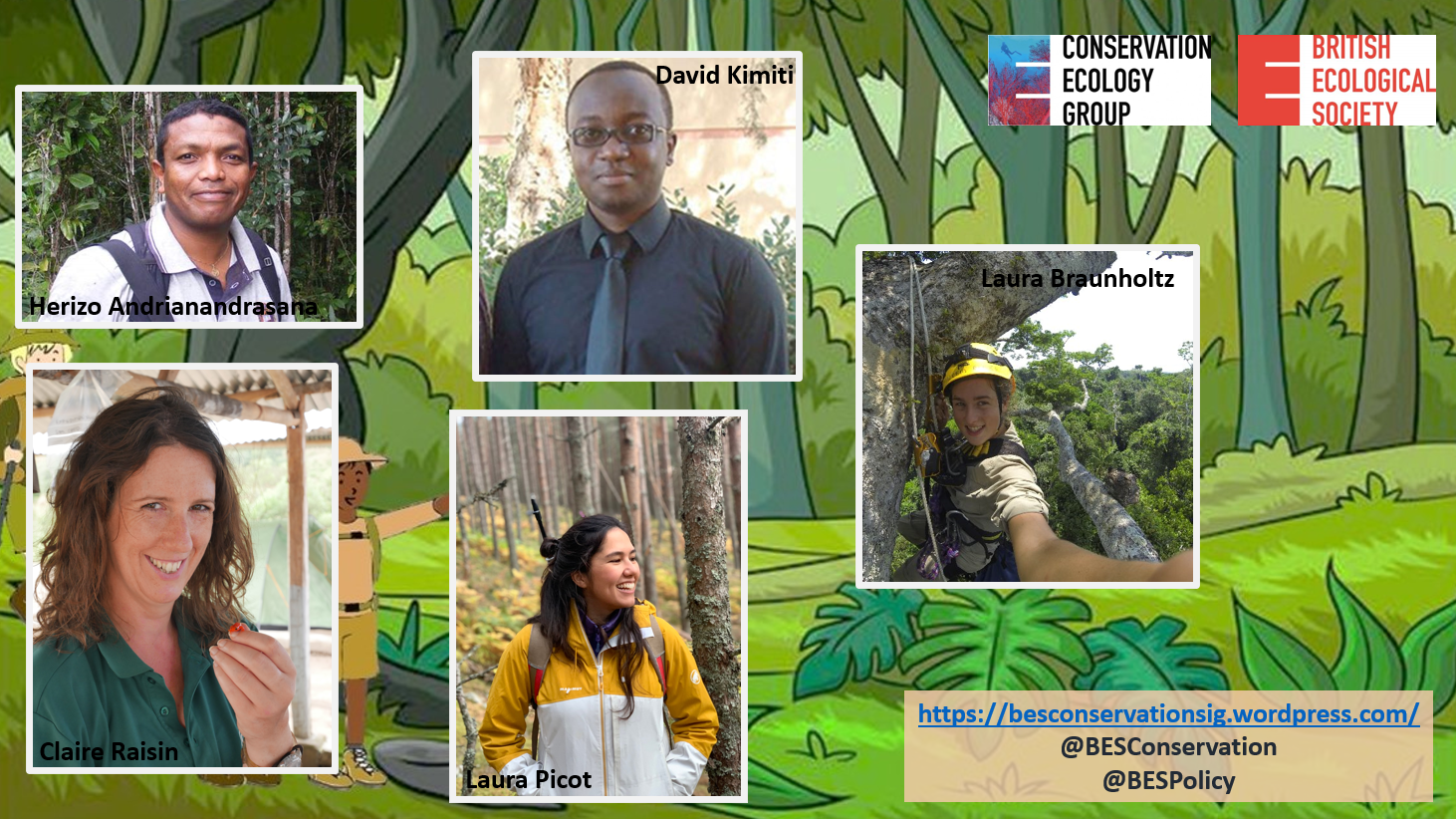
Back in March of 2023, I facilitated an online panel discussion on ‘helicopter science’: what it is, where it commonly arises, and how we might prevent it from happening. The event was hosted jointly by the Conservation Ecology Special Interest Group and Policy Team of the British Ecological Society (BES), after the two groups started to consider how they could better support equitable and inclusive ecological research happening across Majority (Global South) and Minority World (Global North) countries. The international panel (pictured below) kindly gave 90 minutes of their time to discuss this challenging topic. And we barely scratched the surface. If you’d like to read more about what we discussed, the Relational Thinking blog (associated with the journal, People and Nature) has just published our summary piece on the event. I will be co-running a workshop on the theme of equitable international fieldwork at the BES Annual Meeting in December, to provide an opportunity for more discussions, and to motivate action.

Food production in the Fens: navigating towards Net Zero?

Reposting here an article that I wrote recently for the International Peatland Society’s (IPS) Peatlands International (PI) quarterly publication. You can get access to the full publication (after becoming a member), access the back-catalogue for free, and find out who to contact if you want to write for PI here. I post this with thanks to Prof. Sue Page, for commenting on the drafted version, and to Susann Warnecke, for sending me to the FenlandSOIL gathering on behalf of the IPS, and generally for running the IPS ship so fantastically.

If you have ever enjoyed a fresh salad grown on English shores, it is likely to have comprised ingredients harvested from the Fens. A third of the country’s fresh vegetable produce comes from this region; an area of c. 3,900 km2, rich in peat. The Fens, situated across the counties of Lincolnshire and Cambridgeshire, and small parts of Suffolk and Norfolk, comprise lowland agricultural peat soils, the working of which generates some £3 billion each year and employs over 80,000 people. These people and resident communities share this region with 13,000 species of plants and animals, which live within and outside of the agricultural matrix.

Another key characteristic of the Fens is that its use in food production is “an obstacle” to achieving Net Zero by 2050. Centuries of farming in this peat-rich landscape has led to vast, largely unquantified carbon emissions and to extensive wastage of the peat soil. With United Nations Framework Convention on Climate Change (UNFCCC) signatory nations now required to measure, report, and reduce their greenhouse gas emissions across different sources in line with their Nationally Determined Contributions (NDCs) to mitigating climate change, emissions from farming peat soils need to be addressed.

Cue the formation of FenlandSOIL: a cross-sectoral group tasked with exploring how farming in the Fens can be achieved in a carbon-neutral way. This farmer-led consortium was established in 2021, and now has over 80 members from the farming community, academic institutions, and multiple other public and private sector organisations.

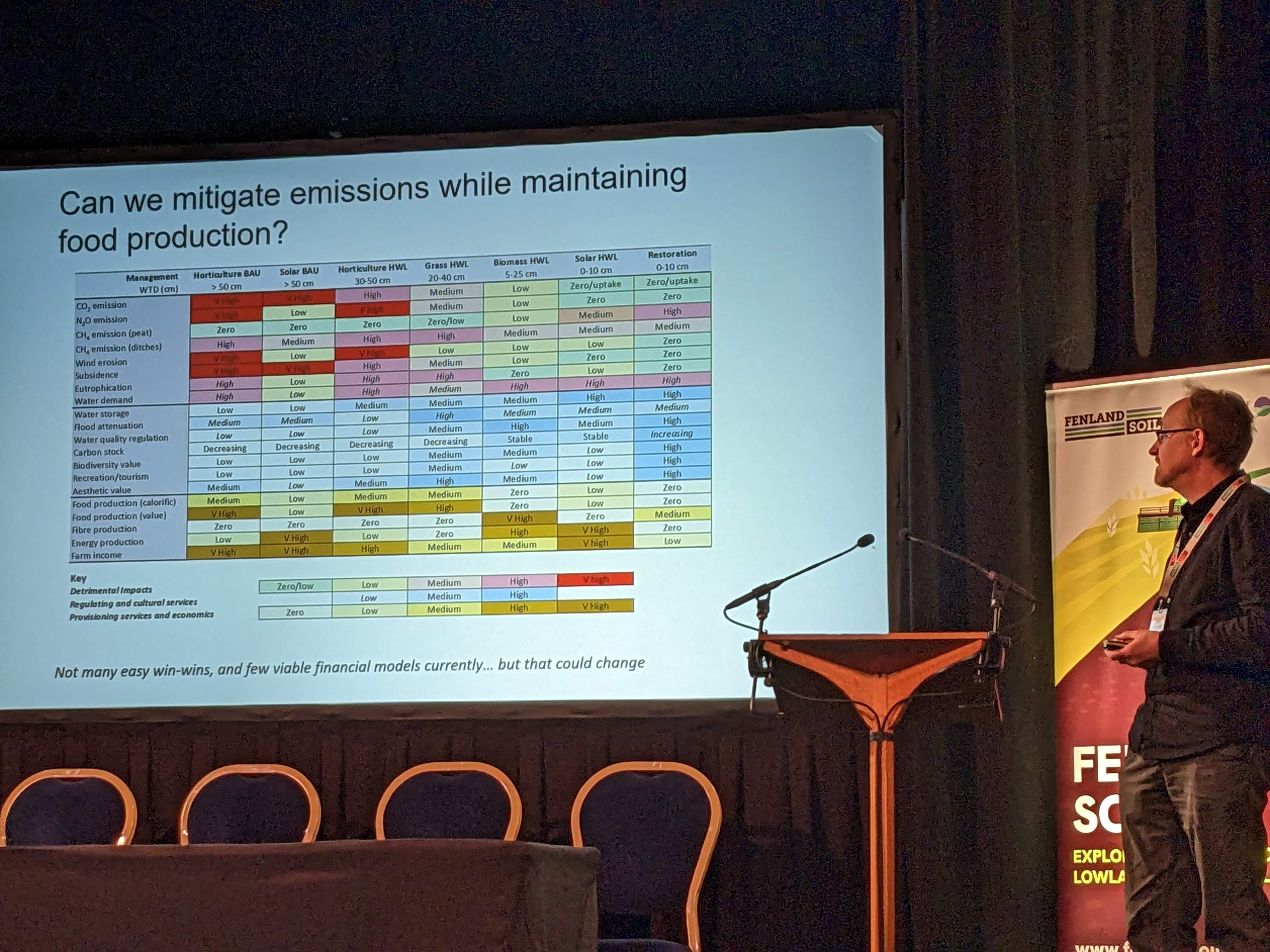
One of the FenlandSOIL associated partnerships is that between the World Wildlife Fund (WWF) and UK-based supermarket chain, Tesco. The goal of their collaboration, and of the FenlandSOIL consortium, is to answer the billion-dollar question: can we mitigate emissions whilst maintaining food production?

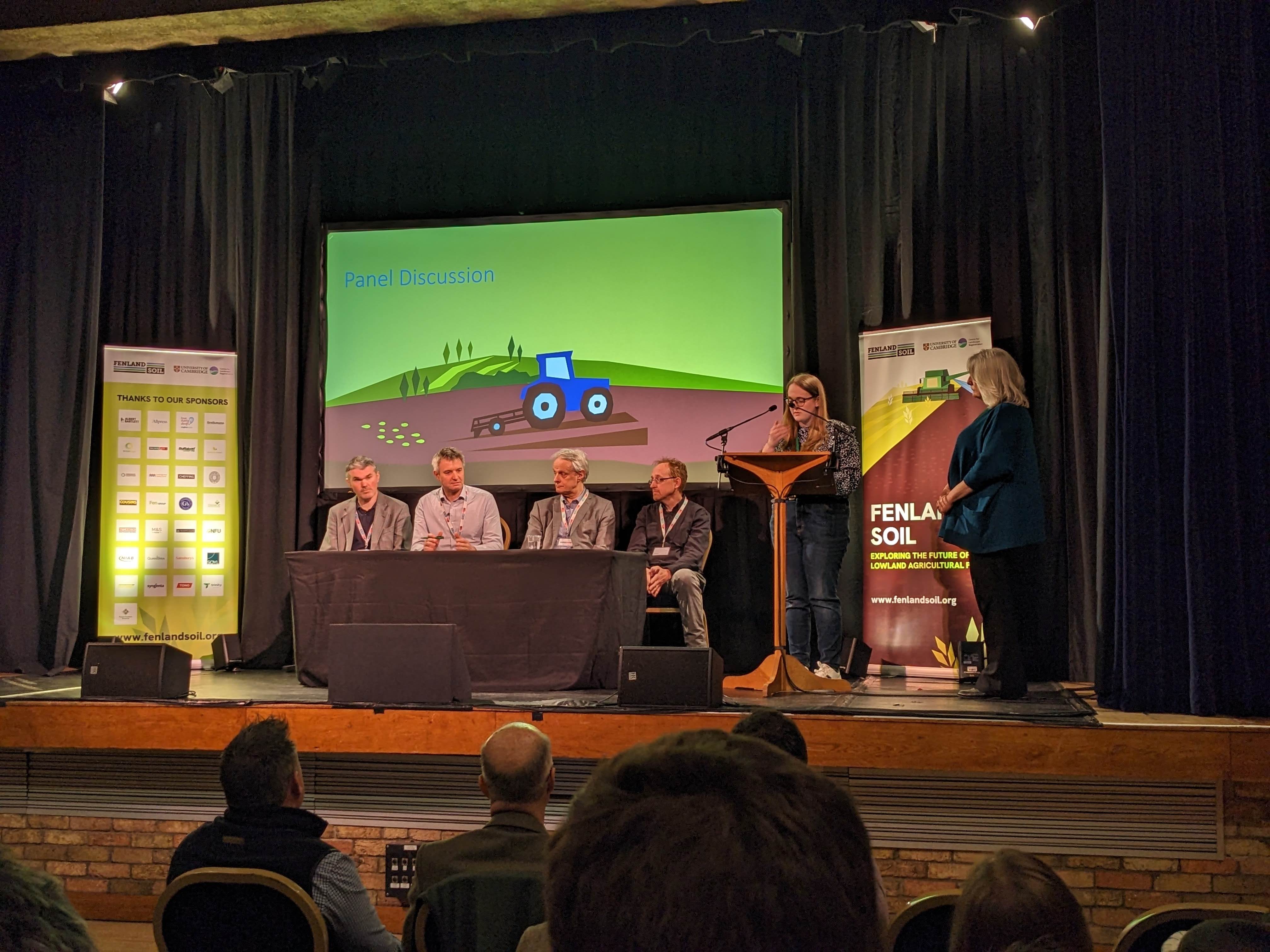
On 17th and 18th April, 2023, over 200 delegates gathered to explore this question, in the small city of Ely in East Cambridgeshire, perched on an island of hard sandstone within a fenland scape. Over the two days, attendees had a chance to mix with individuals from UK Government agencies, universities (including the key collaborators from the University of Cambridge), the National Farmers Union of England and Wales, Wildlife Trusts, supermarket chains, farm equipment suppliers, and an inspiring mix of others.

Alongside the incoming Scientific Officer, Dr Örjan Berglund, I was fortunate to attend this fascinating, inspiring, and at times frustrating meeting of minds on behalf of the International Peatland Society. After attending the two days of presentations, observing smaller group discussions and conversing with a range of different stakeholders in the conference breaks, I identified some common themes that seemed to emerge in this cross-sectoral space. Here are some of my learnings from the event:

  • No ‘one size fits all’ when it comes to developing interventions that will reduce emissions whilst enabling the food production to continue across farms in this peat-rich landscape. We need a framework to support the development of local solutions, which are bottom-up….
  • …and farmer-led. Of course, there is no one size of farmer, with each having a different relationship with the landscape they are farming, but every farmer will have knowledge and experience of that multidimensional space, which must feed heavily into each stage of intervention planning and practice. The depth of knowledge, understanding and passion of farmers attending the meeting was evident. Their voices must be present and centred in policy-facing discussions.
  • One skill-set farmers are often lacking is that required to carry out effective carbon management, being a relatively new role that the already hyper-skilled individuals are being tasked to take on. One farmer I spoke to was confused as to what the best approach to reducing emissions was for his farm – with his particular production system and land cover – after listening to multiple presentations advertising different emissions outcomes of different interventions for diverse production systems on different farms. An evidence-based approach is needed.
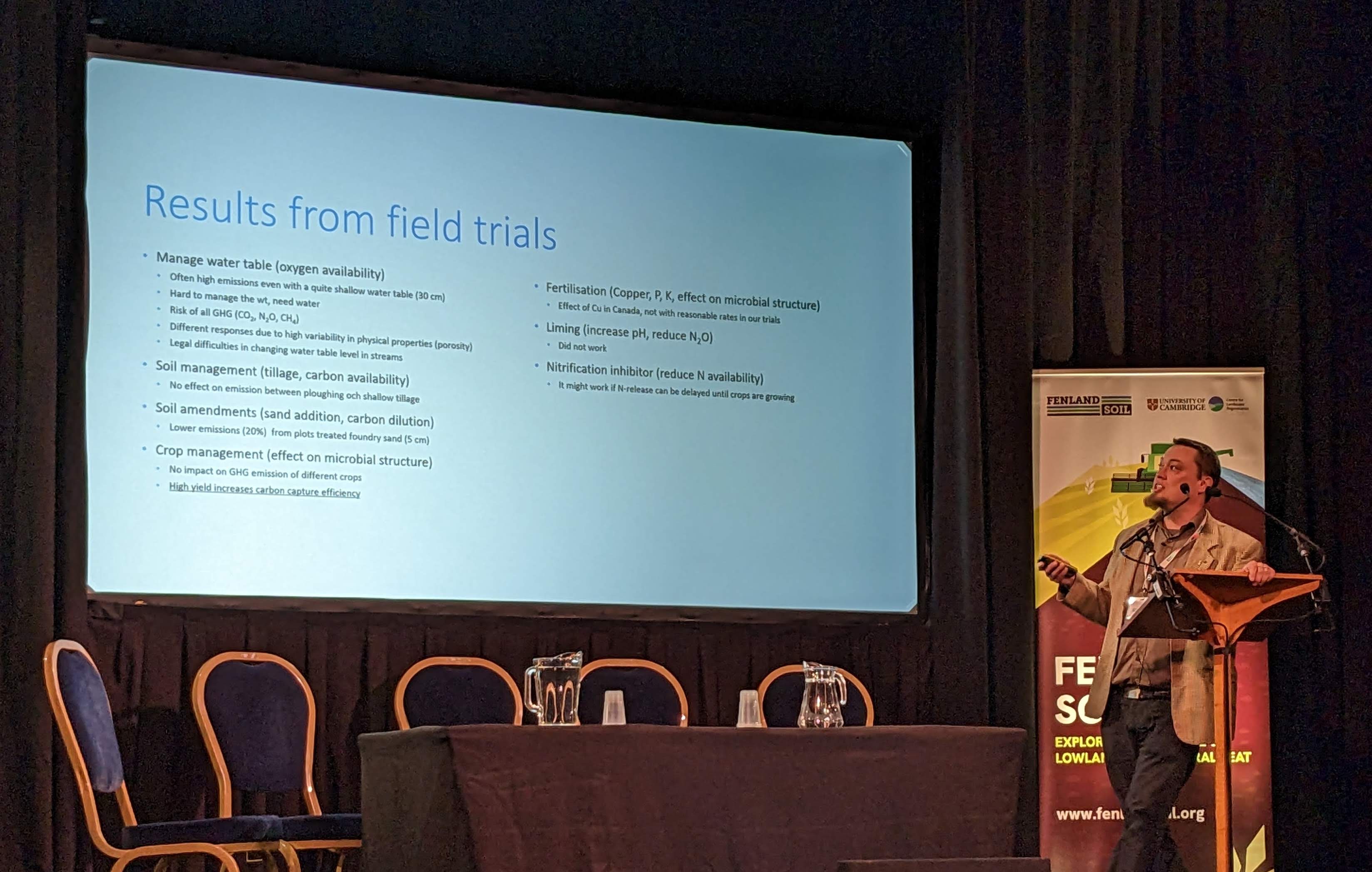
  • There was a call for that evidence-base to focus on “field-scale trials and innovations”; a continuation of the no ‘one size fits all’ principle. When evidence is often place-specific, incomplete, and associated with many uncertainties, packaging it into useful guidance for farmers is one of the ultimate challenges.
  • But whatever specificity of interventions are proposed, monitoring the changes in emissions, food production, soil health, species abundance, etc., and reporting those verified changes is essential, i.e., MRV – a feasible and effective Monitoring, Reporting and Verification procedure. We need to have standard, transparent, and feasible ways of assessing whether interventions are going any way to reducing GHG emissions over time, whilst not jeopardizing food production, livelihoods and other emergent properties of these systems.
  • The somewhat unpredictable elephant in the room – which could undermine even the most well-designed peatland carbon management plans – is climate change. This is seen as a large risk to food production and to climate change mitigation interventions. We need to understand more about how future climatic drying and erratic weather patterns may influence peatland ecosystem health, in order that current and near-future investments in restoring wasted peats are not themselves wasted.
  • The best way of climate-proofing any peatland is to manage the water table. There were plenty of discussions on storage, sharing, and managing risks associated with water across the Fens. From being a resource in abundant supply in this wetland-scape in the past, the lack of water resulting from hundreds of years of drainage is now a significant risk. Internal Drainage Boards (IDBs) are now the institutions who wield the power in these agricultural landscapes; they are in charge of decisions that can determine the economic and literal productivity of farms through water abstraction licencing. Although with transformative consequences on farming, imminent reform in licencing to reduce the exploitation of river water may create opportunities for peatland restoration. However that reform manifests, a short-term reduction in demand for water is needed across the Fens, alongside long-term local planning of water resource management, where the restoration of rivers to “good ecological status” is set as the achievable goal. As an aside, we were also reminded that water-level management in drains is not the same as water-table management in fields; each process plays a separate, yet interconnected role in peat soil conservation and food production.
  • The IDBs are, of course, not acting independently but in line with national legal frameworks for water management. When it comes to policies, Government intervention, be it through legislation or financial support, is seen as a double-edged sword. Although it may not be clear how the Government could support a strategy for food production in the Fens and the variety of lowland peatlands across the UK, there were proposals for how top-level support could reduce barriers to farming in these landscapes. There were discussions relating to England’s reformulated agricultural payment schemes, e.g., the post-Brexit Environmental Land Management scheme (ELMs), and how multiples of these could be ‘stacked’ together on one farm to increase the resources available to farmers to manage these complex landscapes. Where do farmers get the equipment, the seed-stocks, and other materials and expertise (in some cases) necessary for restoring their peatlands? Could logistical barriers also be reduced through policy change?

  • Or ultimately, is the lack of financial support the key challenge? Certainly, comments were made about the current lack of financial models that account for low-emissions farming practices on peatlands. We need a financial vision and framework, to accompany a logistical one.
  • One of these frameworks is carbon financing, and more specifically, the Peatland Code 2.0. The IUCN UK Peatland Programme has worked to revise this standardised procedure for valuing the carbon held in peatlands under protection, with areas of the Fens now eligible for financial investment through the voluntary carbon market under this scheme.
  • Regenerative agriculture is the future, we are told! I would like to believe this. But I am unsure what this is, exactly, and what it might look like in lowland peatland settings. I was reminded of the need to carefully define the terms we are using, lest they become straw men and lose their meaning, and thus power.
  • Whilst sharing learning and experiences across peatland regions can be valuable, we also need to appreciate the unique nature of the Fens. Lowland peatlands behave differently to those in the uplands; the latter being the subject of the majority of financial calculations and modelling for restoration. Lowland peatlands themselves come in a wide range of shapes and sizes….
  • Nuance matters. Variability in soil characteristics, water availability, and management practices across space and through time in the Fens need to be accounted for in any planning and practice. For example, the volume of Nitrous oxide emissions resulting from agriculture on peatlands may depend on the crop being cultivated and its in-field management; this detail matters.

To enable continued food production from the UK’s lowland peatlands, whilst mitigating (to some extent) carbon emissions from damaged peat soils, we need action now. We need a framework for local solutions. We need a field-scale, mosaic approach to interventions. We need to connect up communities and sectors across IDBs, and landscapes. And we need to create opportunities for social innovation. The FenlandSOIL gathering made an inspiring start.

Dr Lydia Cole
Coordinator of IPS Expert Group Peatlands and Biodiversity, University of St Andrews
lesc1@st-andrews.ac.uk

Was it a COP-out?

After a year’s delay, COP26 has now been, and gone. And the next Conference of the Parties, the 27th gathering of the 197 countries who make the decisions on how to fulfil the goals of the United Nations Framework Convention on Climate Change (which they all signed up for), is already being talked about. Next year, each nations’ negotiators, and their support teams, will meet in Egypt to share what they’ve been up to over the last year; what practical actions and/or policy changes and/or plans they’ve made to stick to their ‘promise’ of reducing their country’s greenhouse gas emissions, and by the amount that scientists think is needed in order for the world to stave off dangerous increases in temperature.

Are we not already beyond the dangerous increases stage? I think most scientists would say that the imperative of maintaining temperatures to 1.5°C is already unachievable. And misses the point. Certainly, the details of the agreement of nations made at COP26, to essentially “phase down” rather than “phase out” the use of fossil fuels, will not accelerate our approach to limiting temperature rise to the mythical 1.5°C. But progress was made, I have heard.

Reflecting on the various conversations I’ve had with people much more involved in COP26 than me, and on reports I’ve read from the event, it seems that ‘nature’ and (some of) the voices of (some of) the people who aren’t normally given space at these talks, were considered. Big business is also, necessarily, supporting the development of fora between trading nations and of tools to more accurately monitor supply chains, especially for products coming from countries with vast areas of forests and peatlands, vulnerable to the power of the global commodities trade. The Forest, Agriculture and Commodity Trade (FACT) dialogue is one fora. And Sainsbury’s are one ginormous business having a go at leading the way.

There were numerous individuals attending the Conference who were also leading the way. A great number walked to COP26 from across the UK. One very special guest walked to COP26 from Syria. Little Amal made the journey (with a bit of help!) to tell the “unpalatable truth” about the challenges faced by so many refugees. Michael Morpurgo gives a moving Point of View on the inspiration behind this brave girl. And her presence at COP26 also reminds us of the growing injustice wrought by climate change, in addition to the injustice that has gone into creating it. But I cannot talk with any authority on that subject. On the subject of peat however, I can.

Through my role as the Coordinator of the Expert Group on Peatlands and Biodiversity, of the Scientific Advisory Board of the International Peatland Society, I had the opportunity to give a whistle-stop tour of the peatlands of the Peruvian Amazon to the audience convened by the Global Peatlands Initiative. The UN-led Initiative is a multi-stakeholder partnership that aims to coordinate and share information and expertise with the goal of promoting the conservation and sustainable management of the world’s peatlands. I presented the work of the Tropical Wetlands Consortium to the audience of the Peatland Pavilion at COP26, within the Peatland Partnerships in Climate Change Mitigation and Nature Recovery session, organised by the International Peatland Society. Intact peatlands are increasingly being acknowledged as a key natural way of mitigating against (through absorbing carbon) and preventing further increases in (if not drained & transformed) atmospheric CO2. It was evident from the extensive engagement that the Peatland Pavilion achieved (Michele Obama even popped by, apparently!) that peat is becoming acknowledged as one of the “superstars” of nature-based approaches to achieving Nationally Determined Contributions.

Promising words. Now to action.

Making an impact….in UK environmental policy

On 6th March B.C. (just before lock-down), I organised an event at the snazzy, “gold-standard of sustainability” British Ecological Society Offices in London, to let ecologists know how they can Make an Impact: Understanding the ways they can engage with the UK Parliament and Policy.  The event was held jointly by the Conservation Ecology Special Interest Group and the BES Policy Team.  We had an excellent bunch of speakers and a room-full of engaged attendees.

I thought I’d post some of the resources from the day here:

Now over to you/me/us.  And perhaps now is the time to think about what changes are possible, what a different world could look like A.C. and how we can influence that.

A story of flaming bogs in Borneo

I’ve made a pact with myself that I will write a plain language summary for each paper I publish as the first author, to make my work more accessible for people beyond the ivory tower.  Some journals, e.g. People and Nature, now encourage this for each of their publications.  Whether you believe or not that scientists have a role in advocacy, I believe that sharing the treasure of knowledge with the people that funded our adventure is our responsibility.  And perhaps it’s better to tell the story with scientific facts, than ‘facts’ derived through alternative means?  Here is my first attempt at an accessible summary for my last publication. (Though it’s still too sciency, a good friend pointed out – I’ll try for properly plain next time!  All comments welcome!)

Over the past year, it’s been rare to pass a day without hearing of forests burning, whether in Australia, Brazil or Siberia.  The frequency and intensity of forest fires seem to be increasing, with devastating impacts on people and nature.  But fires in forests are not a new phenomenon and can be vital to the resilience of these ecosystems.  Historical and palaeoecological work can provide context from which to compare these contemporary fires and provide evidence to demonstrate the impact of management and policy.

One type of forest that has gained a global reputation in recent decades for its spectacular fires is degraded tropical peat swamp forest.  In an intact state, these waterlogged ecosystems accumulate carbon under their prevailing anaerobic conditions, making them hugely important for mitigating the effects of rising GHG emissions.  But are fires unique to degraded tropical peatlands or do intact peatlands burn too?

Our recent paper* answered this question for three peatland sites along the coast of northern Borneo, within the Malaysian state of Sarawak.  We collected a set of peat cores from each site and spent many hours in front of the microscope gathering data on elements of the landscape over the last 7,000 years.  Fossil pollen grains were identified to provide knowledge on the floral components of the landscape over time and distinguish major ecosystem types.  Fossil charcoal particles were counted to reconstruct past fire regimes in these swamps, including incidences of forest burning that were above the background levels.  We also looked at a wide range of historical and contemporary literature to explore the interactions that people have had with these peatlands over the last 500 years: the approximate time of people’s arrival in the flooded coastal forests, the changes in land titling and the political pressures on land management in recent millennia.

Our results demonstrate that intact tropical peatlands do burn.  They probably burnt more in years when the El Niño Southern Oscillation (ENSO) – a climatic phenomenon that brings drier, warmer weather to this region in irregular, sub-decadal intervals – was stronger, but the peat swamp forest seemed to recover even from these more intense fires.  However, cue people’s entry into the story, c. 1850s, and the narrative changes.  Fossil charcoal levels reach unprecedented levels, in parallel with indicators of deforestation.  And the peat swamp forest shows signs of losing its long-standing stability – the ecosystem’s resilience appears to be compromised by the simultaneous forces of fire and deforestation.

Many of the forests standing in the Anthropocene have been degraded.  Their resilience has been compromised by unusually low precipitation (resulting from regional climatic drying) or by management interventions that disrupt natural disturbance regimes, or by both, pushing them beyond the limits of their ecological memory.  Our work suggests that tropical peatlands have recovered from episodes of burning throughout the Holocene.  But the presence of people, agriculture and fire in peatlands seems to be a recipe for disaster.  There is no shortage of contemporary literature and news reports supporting the notion that a drained peatland burns.  Our work contributes to the common narrative that for climate change mitigation and for the universal long-term benefit of people and nature, drainage and deforestation are not compatible with sustainable management of tropical peatlands.


*Cole, L.E.S., Bhagwat, S.A., and Willis, K.J. (2019) Fire in the Swamp Forest: Palaeoecological Insights Into Natural and Human-Induced Burning in Intact Tropical Peatlands. Frontiers in Forests and Global Change. https://doi.org/10.3389/ffgc.2019.00048


Friend and FAO

Earlier this year, as a result of making friends at a conference years ago, I had the privilege of working with a bunch of the world’s most knowledgeable peat-ple on this article for the FAO, published to coincide with COP25: Peatlands: the challenge of mapping the world’s invisible stores of carbon and water. (Page 46-57 in the linked document).

Our main message, watered-down, is that mapping peatlands is no easy task and there is still much work to do on the ground, and across the globe….but we are fast working on these knowledge gaps and know enough about the important role that peatlands play in mitigating climatic change that we would be fools to let them squander.