Commenting on carbon credits

I was invited by one of the Features editors at Business Green, “the UK’s leading source of information for the green economy” (Business Green, 2024), to write a response to a piece they’d recently published that claimed (in the title) that “The UK could lead the world on peatland carbon credits”. I accepted the challenge, in part because it would give me an opportunity to learn more about the way the peatland carbon market is currently perceived, and, provide an opportunity for me to clarify and communicate my argument as to why we need to approach this market with caution. Here’s the argument published in Business Green on 28th June 2024.

Careful investment is required to make peatland carbon credits work for the climate

An exciting economic opportunity does not necessarily equate to a feasible ecological one, writes St Andrews University’s Dr Lydia Cole

Up until recently, the UK’s peatlands – found in the murky space between terrestrial habitats and wetlands – only caught the attention of the government when land was sought for agriculture and forestry. Tax incentives in the 1970s and 1980s encouraged the drainage of these landscapes to pave the way for tree planting for timber production. But now, with international commitments under the Paris Agreement to reduce all avoidable sources of carbon emissions, our leaders are obliged to return to the UK’s damaged bogs, which are responsible for five per cent of the UK’s greenhouse gas emissions.

There is no question that blocking drains in peatlands is a necessary step towards restoring them to a healthy condition where they can again sink atmospheric carbon and contribute to mitigating global warming. There are, however, questions to answer around how we restore peatlands effectively, and how we pay for that restoration. After years of trial and error across the Northern Hemisphere, we are piecing together protocols, designing equipment and perfecting techniques for patching together peatlands, and expertise continues to grow, not least through Scotland’s publicly-funded Peatland ACTION programme.


Experience, and thus expertise, on how to fund effective peatland restoration is, however, lacking. In a recent article in BusinessGreen, the managing director of Ridge Carbon Capture Betsy Glasgow-Vasey claimed the UK could lead the world on peatland carbon credits. She may be right, but not right now. Here, I outline five areas of concern that need to be addressed if carbon credits from ‘restored’ peatlands are to contribute to our nation’s net zero goals.


Firstly, there is an assumption that the more money we invest in activities that, on paper, provide a clear pathway to climate change mitigation, the more mitigation we achieve. This is a fairassumption, but we all know how often climate-related goals are met in reality. And we all knowhow wicked and multifaceted a challenge mitigating climate change is. Take carbon credits, for example. They are supposed to lead to reduced greenhouse gases in our atmosphere. However, an UK-based individual or company can currently purchase as many carbon credits as they want via the voluntary carbon market – outside of schemes such as SBTi anyway – with no obligation to reduce their own avoidable emissions, or importantly, to have eliminated all of their avoidable emissions. If the limited stock of the UK’s carbon credits – we don’t have infinite land, let alone peatlands – is spent on such ‘greenwashing’ campaigns, we will run out of our capacity to offset the unavoidable emissions, an essential process on our pathway to achieving net zero.


There seems to be an equally prominent assumption that the reason the UK’s peatlands are not being restored at the target rate is a lack of funding. But recent research in Scotland has suggested quite the opposite. The promise of vast payments from private investors for units of carbon that are currently sat idol is stalling the progress of publicly-funded restoration programmes. Owners and managers of peat assets are facing decision paralysis in an information vacuum: selling carbon credits could mean a reasonable revenue for the current generation, but it could also mean they forfeit access to a valuable resource and leave their inheritors with a stranded asset. The stewards of peatland carbon credits need to understand what selling those credits entails, for them now, and for future stewards. Yet they are struggling to access this information.


Much like there is more than one type of peatland – blanket bogs, raised bogs and fens in the UK –there is more than one type of relationship, pattern of use, land ownership regime, etc. that these stewards have with these multi-use, cultural landscapes. A carbon offsetting scheme in the intensive agricultural landscape of the Cambridgeshire Fens will necessarily look very different to one that succeeds in the crofting landscapes of the Outer Hebrides. Commodifying carbon ignores the unavoidable, and important diversity inherent in each ‘credit’, and a one-size-fits-all market, that treats all peatlands and people the same, will fail.


This market will also fail to address the problem it was created to solve – climate change – if it does not differentiate between types of carbon credits. When you block a drain in a damaged peatland, the hope is that it will start to emit less carbon as a waterlogged landscape re-establishes. This intervention will reduce the volume of carbon being emitted from the peatland initially, and lead to avoided emissions if successful, relative to the business as usual state. Overtime, if drain blocking and revegetation is successful, and climatic drying mild, that peatland might remove carbon from the atmosphere. But peatland ‘restoration’ does not necessarily equate to carbon removals or true carbon offsetting. An exciting economic opportunity does not necessarily equate to a feasible ecological one.

The Scottish Government-funded Peatland ACTION program aims to set peatlands on a “road to recovery” – to carbon sequestration in line with Scotland’s Climate Change Plan outcomes. The conditions and outcomes tied to private investments, dictated and verified via the IUCN’s Peatland Code, are necessarily prioritising market resilience above ecological. It is, of course, imperative that credit schemes entail standards that imbue confidence in investors and are paired with a healthy market through which they can flow. However, the origin of any carbon credit is a unit of carbon, and in the case of peatlands, that unit represents a real block of dark, thick, wet peat, set in a healthy ecosystem. These blocks of carbon are fragile, only replaced on millennial timescales, and will not necessarily stay put through a price tag.

A key solution to all of these notable challenges is government regulation. Carbon credits must only be available for purchase by those companies that have eliminated all of their avoidable emissions and are looking to invest – not make profit from – nature-based offsetting opportunities. And we need to be more careful with the descriptors and phrases we use to rally the crowds: “high-integrity” offsets must hold true, and “level-up the peatland industry” – what does that mean? An obligatory carbon market, similar to the UK Emission Trading Scheme (ETS), building on the ‘polluter pays’ principle, needs to have the capacity to support flexible payment models that direct funding to locally-appropriate peatland restoration or responsible management schemes. Learning from the roll-out of the Environmental Land Management Scheme (ELMS) in England, or Piloting an Outcomes Based Approach in Scotland (PoBAS) could help to build a more nuanced, more effective approach to peatland restoration that supports rural communities and leads to long-term investment in the landscapes that could make or break our collective future.


Dr Lydia Cole is lecturer at the School of Geography & Sustainable Development at University of St Andrews; chair of the Expert Group: Peatlands and Biodiversity, within the Peatlands and Environment Commission of the International Peatland Society’s Scientific Advisory Board; and Chair of Conservation Ecology Special Interest Group at the British Ecological Society.

Peatlands & private finance: recipe for …?!

In late summer of 2022, myself and my wonderful frolleague, Dr Conny Helmcke, were awarded funding to work on an interdisciplinary project with the broad remit of exploring how communities in rural Scotland are making decisions about whether, why and how to restore peatlands. I thought Conny’s work on environmental justice-related themes was very cool and wanted to learn from her, so approached her to see if we could work together. A few months later, we were awarded some funds from the University of St Andrews (with thanks!) to hire a research assistant, who could collect data to explore this theme (Conny and me being ‘tied up’ with teaching). We are ever grateful to Ewan Jenkins for doing such a fantastic job of building the relationships and understanding central to the success of this project, and in the depths of a Hebridean winter.

The main output of the project, as outlined below, is a set of online (and print, on request) resources for the crofting communities that we worked with in rural Scotland. We have also published a Correspondence piece in Nature (with an open access draft here) and an article for The Conversation. And back in March of 2024, as a result of submitting evidence to a formal call, I was invited to attend the 12th Meeting of the Scottish Parliament’s Committee on Net Zero, Energy and Transport, as an invited witness to give evidence on the opportunities and impacts of natural capital finance in the Scottish context. The first set of witnesses (principally representing private landowners across Scotland) focused on the importance of private finance (and the importance of derisking private finance using public funds) for nature restoration and the achievement of net zero goals/climate change mitigation; the second set of witnesses (from Community Land Scotland, Scottish Wildlife Trust, and researchers, including me) focused on the current challenges of the focus on private finance for achieving these same goals. Here are some links to: the agenda for the session, our written evidence (Clerk Paper 1 – Annexe C), the recording of the session (starting at 10:48:00) and the Official Report. The experience was as interesting and enlightening (about the/our political process) as it was frustrating.

There are so many questions still to answer around how we can support peatland restoration whilst supporting communities, in the current climate of carbon markets, amongst other uncertainties. I hope this project doesn’t end here.

** 

To give some more information on the project and resources for communities, here is an article that I wrote for the International Peatland Society’s Peatlands International quarterly communication.

Peatland ACTION assisted restoration of peatlands underway in the north of Lewis, Outer Hebrides. (Credit: Lydia Cole)

If you’re a crofter in Scotland, wanting to restore the peatland ecosystems within your communal grazing land, how do you go about it? If you have the opportunity to take advantage of public funds so that restoration costs you nothing, should you take it? Or should you agree to sell the carbon locked up in your newly restored peatland to a company or a broker, to provide you with extra revenue and them with credits to offset their emissions? What are the costs and benefits of different pathways to restoration? And how might you gain, or lose, from peatland restoration itself?

In October of 2023, colleagues and I launched an online set of resources designed to answer these questions for crofting communities living in rural Scotland, to assist them in making decisions about how to navigate peatland restoration. (Crofters are individuals who have tenure or use of a small plot of land, i.e., a croft, traditionally in the Highlands and Islands of Scotland, where commonly part of their income is obtained from farming that croft and a larger area of communal land to which they have rights to graze animals.) The website housing these resources: Peatland Restoration: A Guide for Crofting Communities, contains a downloadable Executive Summary and extended Booklet outlining some of the key considerations for crofting communities embarking on, or under pressure to engage in peatland restoration activities. Alongside these, we provide responses to common questions that arose during a period of field research carried out in the spring of 2023 in Lewis, Outer Hebrides, in the form of FAQ, as well as a glossary of terms, to facilitate understanding of the unfamiliar words and complex phrasings common in discussions around carbon credits and associated carbon markets. All of these resources (bar the FAQ) are available in English and Gáidhlig (Scots Gaelic), reflecting the languages spoken in the communities they have been designed for.

These crofter-facing guidance materials are the result of a nine-month project funded by the St Andrews Interdisciplinary Research Support scheme, awarded from the University of St Andrews, Scotland. The research underpinning the resources was carried out by a team from the University of St Andrews, led by myself and Dr Cornelia Helmcke, with Ewan Jenkins employed as a Research Fellow, and Dr Bobby Macaulay, (coordinator of the Community Landownership Academic Network (CLAN), University of the Highlands and Islands) and Drs Shona Jenkins and Milinda Banarjee (University of St Andrews), as Co-Investigators. At project inception, Cornelia and I engaged various people to understand if our research questions were pertinent and could yield information of use in the development of informed policies on peatland restoration in rural Scotland. Bobby Macaulay provided invaluable feedback on our ideas and contacts for the project, one of which was the Peatland ACTION Officer in Lewis, Ben Inglis-Grant. We thank him for the time and wisdom he shared with us over the full course of the project. Peatland ACTION is the government scheme that funds and provides logistical support for the restoration of peatlands in Scotland. Peatland ACTION is not to be confused with the Peatland Code, a UK Government-backed scheme that acts as a standard against which carbon credits resulting from peatland-based restoration projects can be verified, enabling them then to be sold on the domestic voluntary carbon market. Our project explored the challenges and opportunities associated with the different pathways to restoring peatland ecosystems within crofting communities in rural Scotland, in order to provide insights for what is necessarily a rapidly developing area of policy around natural capital markets and net zero accounting. For an important critique of the carbon market in the context of achieving net zero in the UK, pertinent to the drive for peatland carbon credits, we recommend Andy Wightman’s blog.

The website and associated resources are being disseminated to crofting communities and organisations, researchers and policy groups, and anyone who might be able to make use of the information to better understand what support and regulation is needed to help communities navigate the new potential to earn money from carbon held within, or in the case of peatlands, not emitted from landscapes if they are restored (i.e., avoided emissions if ‘Business as Usual’ scenarios continued). If you have feedback on the resources and/or would like physical copies of the Executive Summary or Booklet, please email peatlandguide@st-andrews.ac.uk.

Food production in the Fens: navigating towards Net Zero?

Reposting here an article that I wrote recently for the International Peatland Society’s (IPS) Peatlands International (PI) quarterly publication. You can get access to the full publication (after becoming a member), access the back-catalogue for free, and find out who to contact if you want to write for PI here. I post this with thanks to Prof. Sue Page, for commenting on the drafted version, and to Susann Warnecke, for sending me to the FenlandSOIL gathering on behalf of the IPS, and generally for running the IPS ship so fantastically.

If you have ever enjoyed a fresh salad grown on English shores, it is likely to have comprised ingredients harvested from the Fens. A third of the country’s fresh vegetable produce comes from this region; an area of c. 3,900 km2, rich in peat. The Fens, situated across the counties of Lincolnshire and Cambridgeshire, and small parts of Suffolk and Norfolk, comprise lowland agricultural peat soils, the working of which generates some £3 billion each year and employs over 80,000 people. These people and resident communities share this region with 13,000 species of plants and animals, which live within and outside of the agricultural matrix.

Another key characteristic of the Fens is that its use in food production is “an obstacle” to achieving Net Zero by 2050. Centuries of farming in this peat-rich landscape has led to vast, largely unquantified carbon emissions and to extensive wastage of the peat soil. With United Nations Framework Convention on Climate Change (UNFCCC) signatory nations now required to measure, report, and reduce their greenhouse gas emissions across different sources in line with their Nationally Determined Contributions (NDCs) to mitigating climate change, emissions from farming peat soils need to be addressed.

Cue the formation of FenlandSOIL: a cross-sectoral group tasked with exploring how farming in the Fens can be achieved in a carbon-neutral way. This farmer-led consortium was established in 2021, and now has over 80 members from the farming community, academic institutions, and multiple other public and private sector organisations.

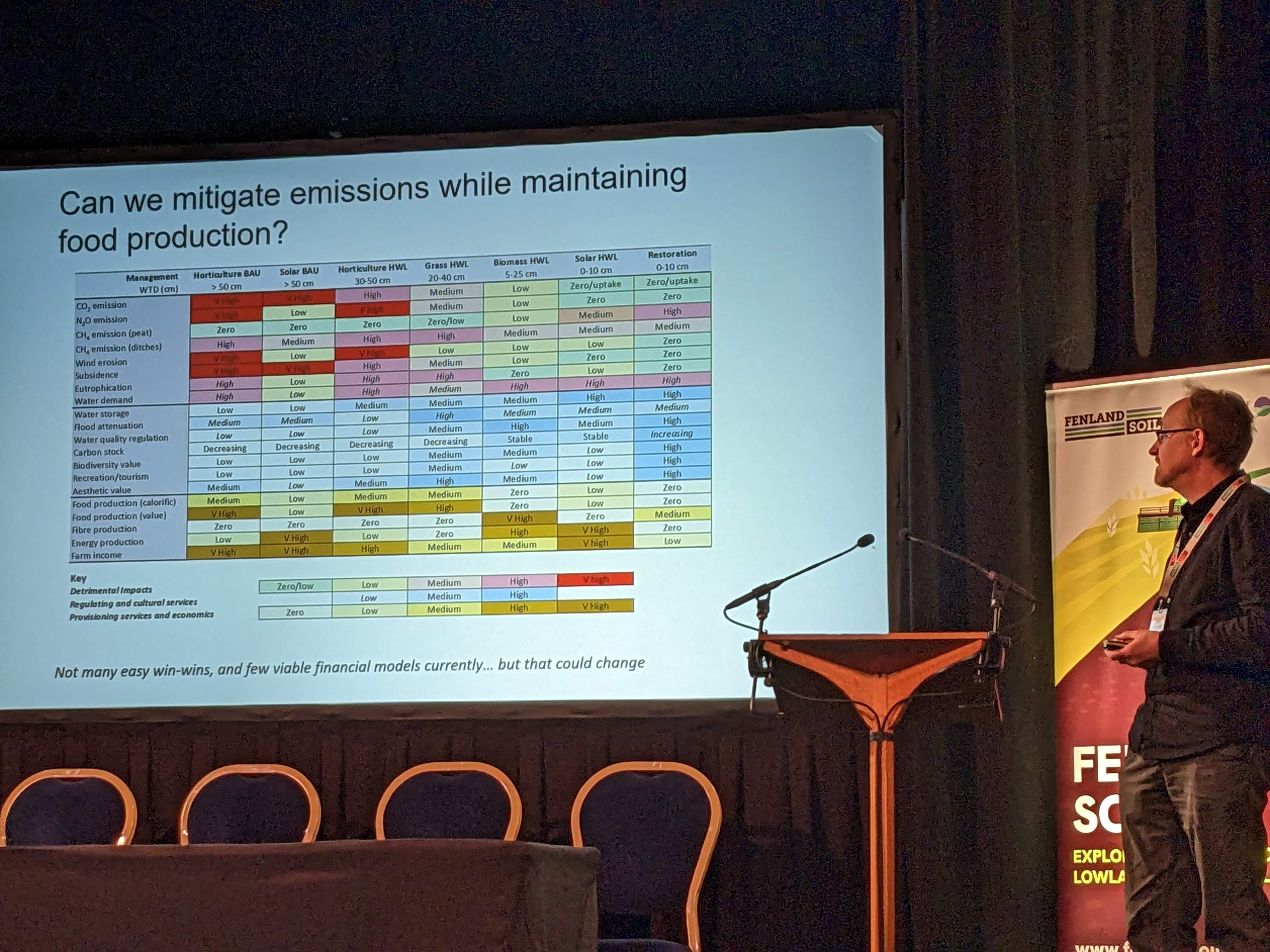
One of the FenlandSOIL associated partnerships is that between the World Wildlife Fund (WWF) and UK-based supermarket chain, Tesco. The goal of their collaboration, and of the FenlandSOIL consortium, is to answer the billion-dollar question: can we mitigate emissions whilst maintaining food production?

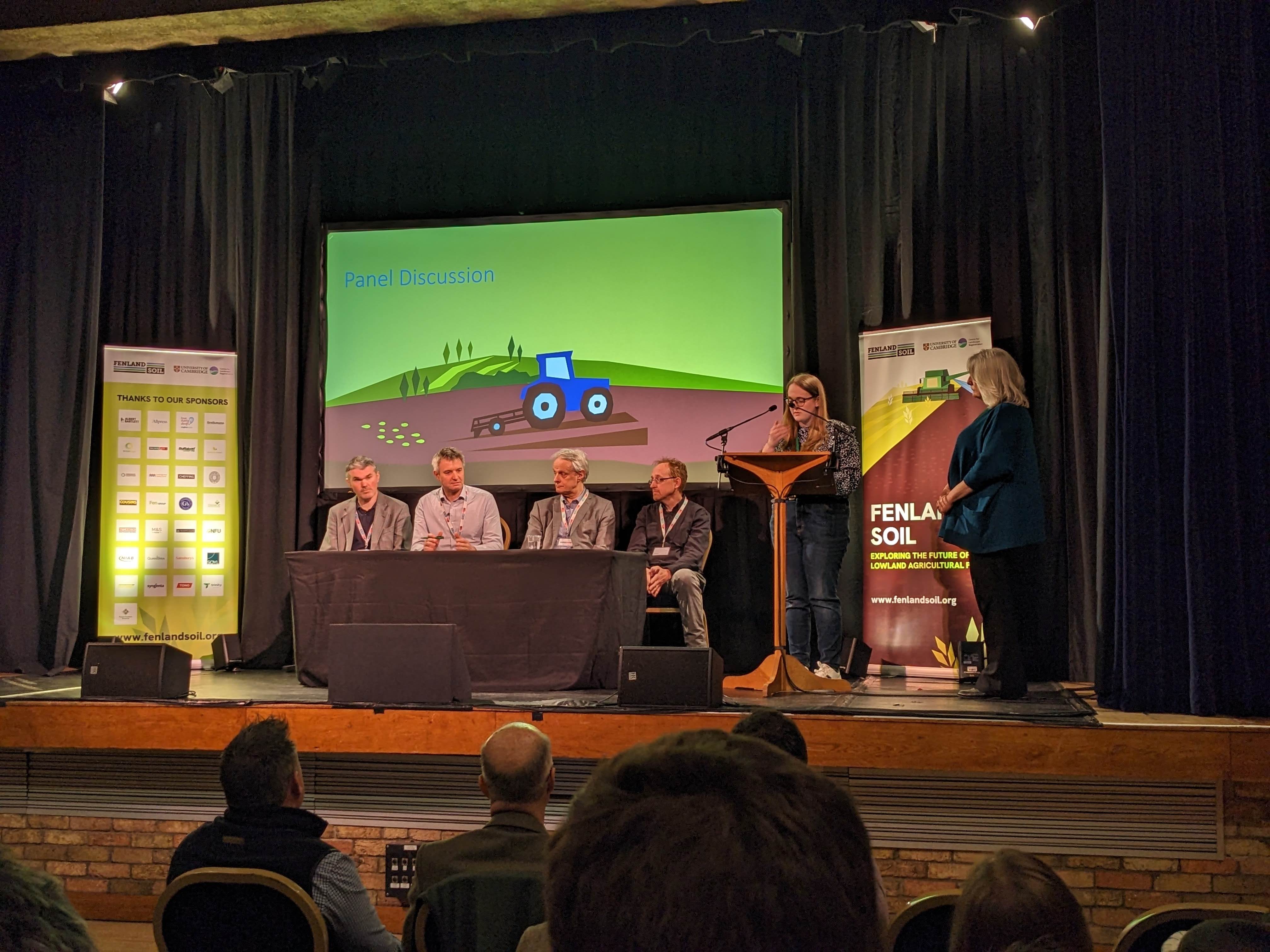
On 17th and 18th April, 2023, over 200 delegates gathered to explore this question, in the small city of Ely in East Cambridgeshire, perched on an island of hard sandstone within a fenland scape. Over the two days, attendees had a chance to mix with individuals from UK Government agencies, universities (including the key collaborators from the University of Cambridge), the National Farmers Union of England and Wales, Wildlife Trusts, supermarket chains, farm equipment suppliers, and an inspiring mix of others.

Alongside the incoming Scientific Officer, Dr Örjan Berglund, I was fortunate to attend this fascinating, inspiring, and at times frustrating meeting of minds on behalf of the International Peatland Society. After attending the two days of presentations, observing smaller group discussions and conversing with a range of different stakeholders in the conference breaks, I identified some common themes that seemed to emerge in this cross-sectoral space. Here are some of my learnings from the event:

  • No ‘one size fits all’ when it comes to developing interventions that will reduce emissions whilst enabling the food production to continue across farms in this peat-rich landscape. We need a framework to support the development of local solutions, which are bottom-up….
  • …and farmer-led. Of course, there is no one size of farmer, with each having a different relationship with the landscape they are farming, but every farmer will have knowledge and experience of that multidimensional space, which must feed heavily into each stage of intervention planning and practice. The depth of knowledge, understanding and passion of farmers attending the meeting was evident. Their voices must be present and centred in policy-facing discussions.
  • One skill-set farmers are often lacking is that required to carry out effective carbon management, being a relatively new role that the already hyper-skilled individuals are being tasked to take on. One farmer I spoke to was confused as to what the best approach to reducing emissions was for his farm – with his particular production system and land cover – after listening to multiple presentations advertising different emissions outcomes of different interventions for diverse production systems on different farms. An evidence-based approach is needed.
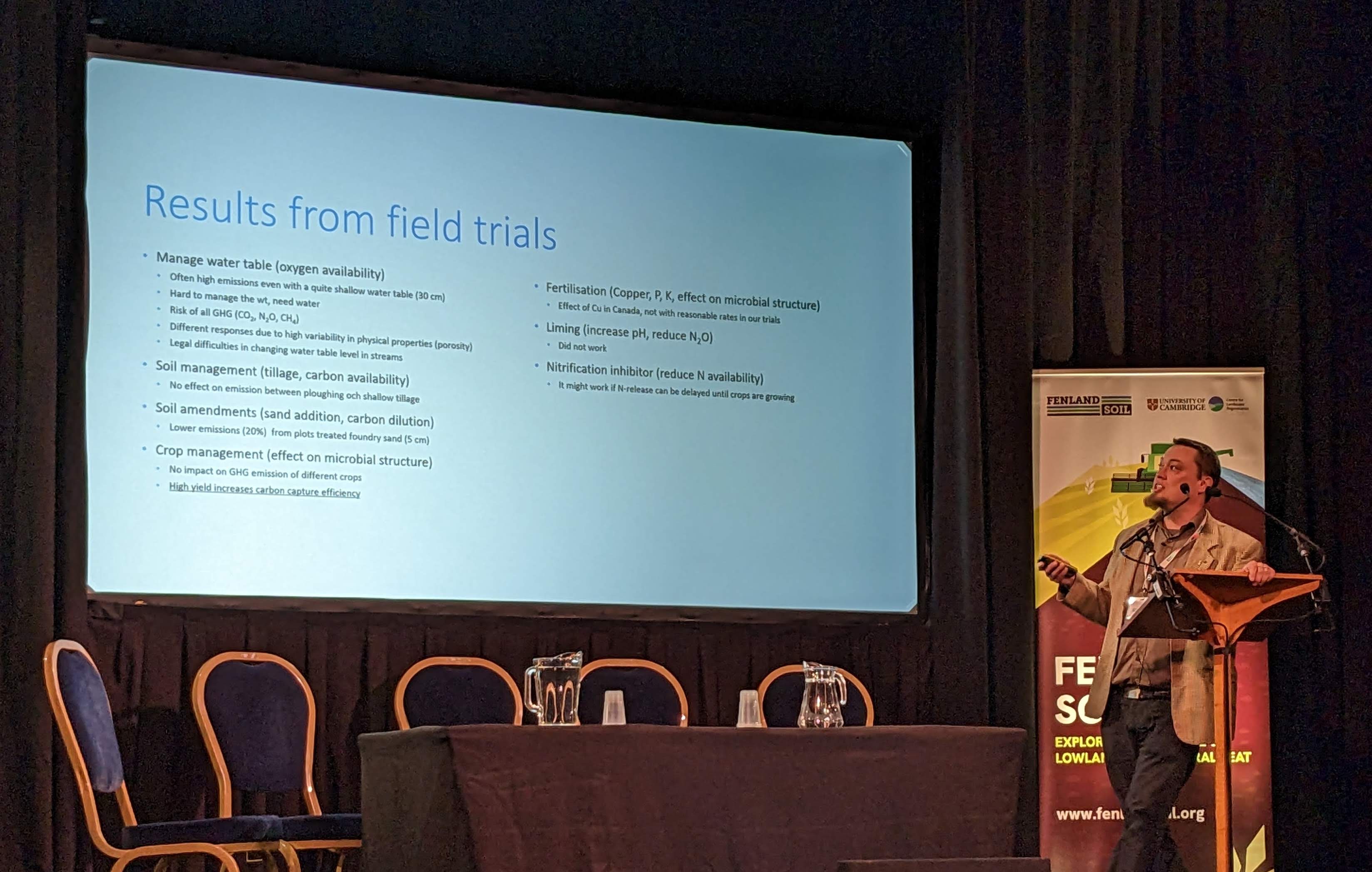
  • There was a call for that evidence-base to focus on “field-scale trials and innovations”; a continuation of the no ‘one size fits all’ principle. When evidence is often place-specific, incomplete, and associated with many uncertainties, packaging it into useful guidance for farmers is one of the ultimate challenges.
  • But whatever specificity of interventions are proposed, monitoring the changes in emissions, food production, soil health, species abundance, etc., and reporting those verified changes is essential, i.e., MRV – a feasible and effective Monitoring, Reporting and Verification procedure. We need to have standard, transparent, and feasible ways of assessing whether interventions are going any way to reducing GHG emissions over time, whilst not jeopardizing food production, livelihoods and other emergent properties of these systems.
  • The somewhat unpredictable elephant in the room – which could undermine even the most well-designed peatland carbon management plans – is climate change. This is seen as a large risk to food production and to climate change mitigation interventions. We need to understand more about how future climatic drying and erratic weather patterns may influence peatland ecosystem health, in order that current and near-future investments in restoring wasted peats are not themselves wasted.
  • The best way of climate-proofing any peatland is to manage the water table. There were plenty of discussions on storage, sharing, and managing risks associated with water across the Fens. From being a resource in abundant supply in this wetland-scape in the past, the lack of water resulting from hundreds of years of drainage is now a significant risk. Internal Drainage Boards (IDBs) are now the institutions who wield the power in these agricultural landscapes; they are in charge of decisions that can determine the economic and literal productivity of farms through water abstraction licencing. Although with transformative consequences on farming, imminent reform in licencing to reduce the exploitation of river water may create opportunities for peatland restoration. However that reform manifests, a short-term reduction in demand for water is needed across the Fens, alongside long-term local planning of water resource management, where the restoration of rivers to “good ecological status” is set as the achievable goal. As an aside, we were also reminded that water-level management in drains is not the same as water-table management in fields; each process plays a separate, yet interconnected role in peat soil conservation and food production.
  • The IDBs are, of course, not acting independently but in line with national legal frameworks for water management. When it comes to policies, Government intervention, be it through legislation or financial support, is seen as a double-edged sword. Although it may not be clear how the Government could support a strategy for food production in the Fens and the variety of lowland peatlands across the UK, there were proposals for how top-level support could reduce barriers to farming in these landscapes. There were discussions relating to England’s reformulated agricultural payment schemes, e.g., the post-Brexit Environmental Land Management scheme (ELMs), and how multiples of these could be ‘stacked’ together on one farm to increase the resources available to farmers to manage these complex landscapes. Where do farmers get the equipment, the seed-stocks, and other materials and expertise (in some cases) necessary for restoring their peatlands? Could logistical barriers also be reduced through policy change?

  • Or ultimately, is the lack of financial support the key challenge? Certainly, comments were made about the current lack of financial models that account for low-emissions farming practices on peatlands. We need a financial vision and framework, to accompany a logistical one.
  • One of these frameworks is carbon financing, and more specifically, the Peatland Code 2.0. The IUCN UK Peatland Programme has worked to revise this standardised procedure for valuing the carbon held in peatlands under protection, with areas of the Fens now eligible for financial investment through the voluntary carbon market under this scheme.
  • Regenerative agriculture is the future, we are told! I would like to believe this. But I am unsure what this is, exactly, and what it might look like in lowland peatland settings. I was reminded of the need to carefully define the terms we are using, lest they become straw men and lose their meaning, and thus power.
  • Whilst sharing learning and experiences across peatland regions can be valuable, we also need to appreciate the unique nature of the Fens. Lowland peatlands behave differently to those in the uplands; the latter being the subject of the majority of financial calculations and modelling for restoration. Lowland peatlands themselves come in a wide range of shapes and sizes….
  • Nuance matters. Variability in soil characteristics, water availability, and management practices across space and through time in the Fens need to be accounted for in any planning and practice. For example, the volume of Nitrous oxide emissions resulting from agriculture on peatlands may depend on the crop being cultivated and its in-field management; this detail matters.

To enable continued food production from the UK’s lowland peatlands, whilst mitigating (to some extent) carbon emissions from damaged peat soils, we need action now. We need a framework for local solutions. We need a field-scale, mosaic approach to interventions. We need to connect up communities and sectors across IDBs, and landscapes. And we need to create opportunities for social innovation. The FenlandSOIL gathering made an inspiring start.

Dr Lydia Cole
Coordinator of IPS Expert Group Peatlands and Biodiversity, University of St Andrews
lesc1@st-andrews.ac.uk

From steaming swamp to blanket bog… We’re live!

After many more hours, and months of work than initially anticipated, our exhibition of Peruvian peatland pics is live. I sketched the article below with colleagues for publicity purposes; this press release adds a few more details. And the exhibition itself is available to everyone everywhere fortunate enough to have an internet connection: https://peatlands.wp.st-andrews.ac.uk/. Compiling the exhibition has very much been a team effort, with colleagues Katy Roucoux and Althea Davies. I’ve learnt a huge amount from their invaluable input and feedback on all aspects of this ‘outreach’ project. I hope we’ve created an accessible narrative that will inspire people to look twice at peatlands, temperate and tropical, and to consider what role they play in all of our lives. I’ve also learnt, the hard way, about the need to balance what can be a very diverse portfolio of work in academia, with publications still being the unit of currency and stamp of expertise for the (academic and employment) world. Now to learning how to achieve that balance before it’s too late…

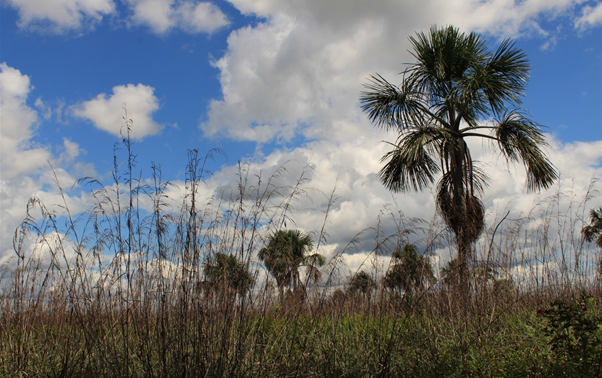
An open peatland ecosystem in the Peruvian Amazon. Credit: Lydia Cole. To view the caption to accompany this image visit: https://peatlands.wp.st-andrews.ac.uk/.

This autumn, a touch of the tropical has come to southeast Scotland. From early August until late October, 2021, the St Andrews Botanic Gardens are hosting a photography exhibition all about Peru’s lowland tropical peatlands. Lydia Cole, Katy Roucoux and Althea Davies, lecturers from the School of Geography and Sustainable Development at the University of St Andrews, in collaboration with the Botanic Gardens and with funding from the British Ecological Society and The Leverhulme Trust, have curated a collection of photographs that take you on a tour of the steaming swamps of the Peruvian Amazon.

The selected photographs were taken by researchers from the Universities of St Andrews, Edinburgh and Leeds, and the Instituto de Investigaciones de la Amazonía Peruana (IIAP, Institute for Research on the Peruvian Amazon) across ten years of fieldwork in Peru’s peatlands. The exhibition explores three key themes: ecosystems – highlighting the “ecosystem engineers” responsible for carbon storage; fieldwork – describing experiences of data collection in the swamps; and people – illuminating the communities and activities associated with the peatlands.

In addition to the physical exhibition, a virtual gallery is housing the photographs and captions to provide online access to audiences near and far: www.peatlands.wp.st-andrews.ac.uk. The website is also available in Spanish and will be live beyond when the exhibition closes at the Botanic Gardens at the end of October 2021. When accessibility improves in Peru and COVID-cases stabilise, colleagues from IIAP plan to display a Spanish-language version of the exhibition in a National Reserve in the Amazonian region of Peru.

Peatlands are a distinctive type of ecosystem where the surface vegetation contributes to, and lives on top of, layers of accumulating peat. Peat is made up of leaves, roots and partially decomposed organic matter, which builds up when waterlogged, low-oxygen, low-nutrient conditions prevent decomposer organisms from recycling dead plant remains. Over hundreds to thousands of years, a thick layer of carbon-rich peat accumulates. With climate change a key challenge faced by global society, conserving the carbon stored in peatlands is becoming an international priority for mitigation efforts.

Peatlands make up over 20% of the land area in Scotland. The most common type of peatland is a blanket bog, where layers of peat carpet the bedrock, forming waterlogged, mossy and shrubby landscapes. In the Peruvian Amazon, peatlands look very different as they are generally forested and often flooded; they are the archetypal ‘swamp’. Over 80% of Scotland’s peatlands are thought to be degraded, whilst Peru’s peatlands are mostly still in an intact state.

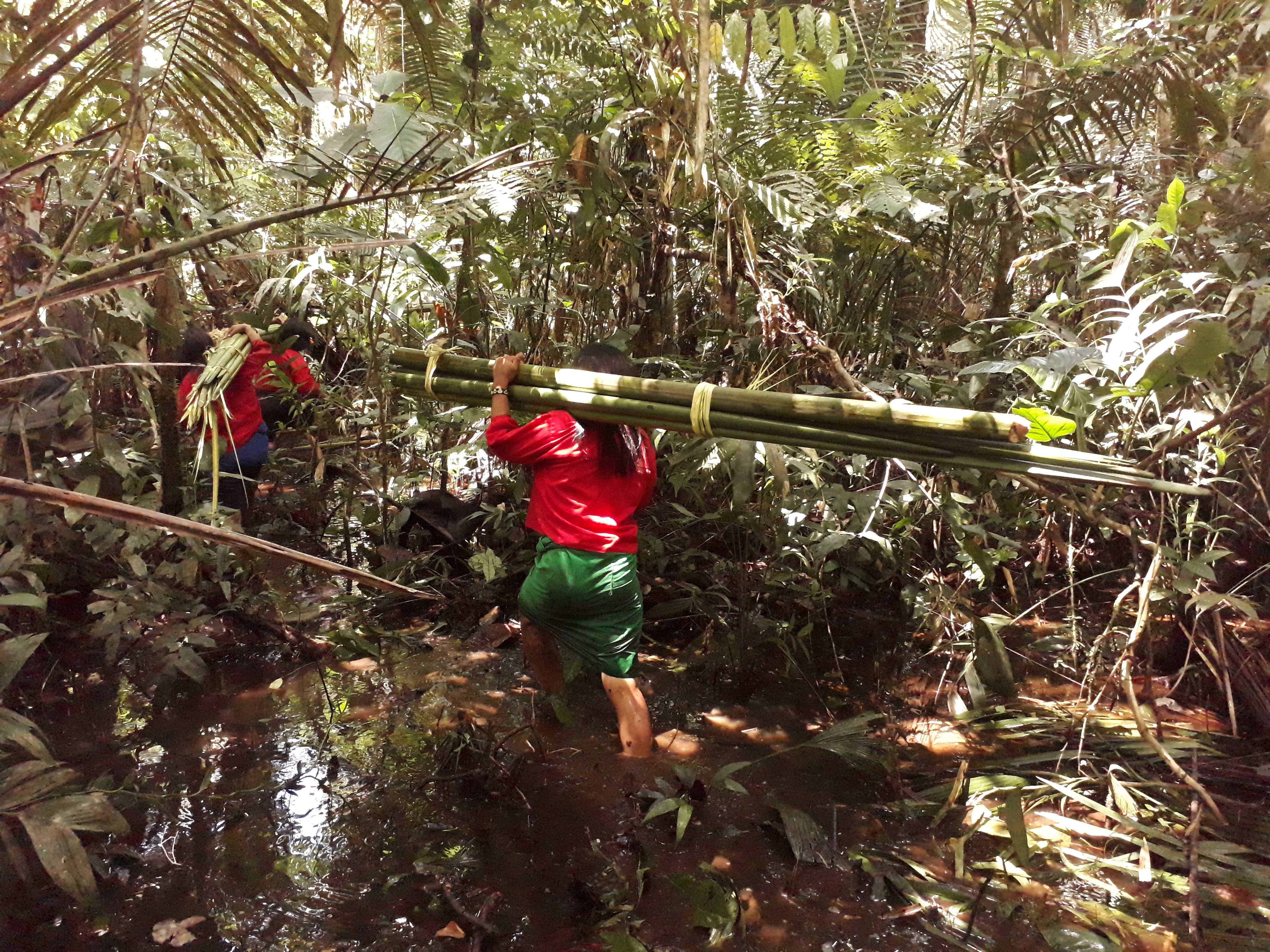
Indigenous Urarina women harvesting Mauritia flexuosa palm shoots from a peatland palm swamp in the Peruvian Amazon. Credit: Lydia Cole.

Researchers at the University of St Andrews and other members of the Tropical Wetlands Consortium, are measuring and mapping the distribution of carbon within the Peruvian Amazon peatlands, the biodiversity they contain and their long-term dynamics, to understand how they develop over centuries to thousands of years. Other projects, as many of the photographs highlight, are exploring the value, meaning and cultural importance of the peatlands to the communities who live there. The photographs in the exhibition have been selected to provide an insight into not only these peatland ecosystems and the people who live in and around them, but also the experience of doing research in these carbon-rich environments. You can find out more about the different projects and team members at www.tropicalwetlands.wp.st-andrews.ac.uk.

If you do have a look at the exhibition and it leaves you with questions or comments, the curators would love to hear them. Please email Lydia Cole (lesc1@st-andrews.ac.uk) if you have any feedback.

The Jungle Book Part II: Still no Paddington

I return to tell a few tales of my recent stint of fieldwork in the Peruvian Amazon, as part of the Leverhulme Trust-funded project: Valuing Intact Tropical Peatlands: an Interdisciplinary Challenge.

In early December, I returned to a cold and dark Scotland after two months in a warm and sunny Peru. Although, after spending weeks in mosquito-ridden swamps, it was a relief to at least leave them behind. The warmth and sunshine, less so!

Since early October, I had been based, along with Luis, another postdoctoral fellow from the University of St Andrews, and Charlotte, from the University of Edinburgh, in the central Amazonian town of Iquitos; the largest city without a road connection to the rest of the world. We spent several days there in between trips, organising the logistics, equipment and food for each period of fieldwork. All of our work is done in collaboration with, and would be impossible without, the fantastic team of ecologists and anthropologists based at IIAP (Instituto de las Investigaciones de la Amazonía Peruana).

This recent trip upstream to the Pastaza-Marañón Foreland Basin was the second of two that we made as a group in 2019. I wrote a bit about the previous one here. Earlier in the year we didn’t have time to visit all of the four communities we intended to, so returned to spend time in and collect data from the final two: Nueva Pandora (on the Tigrillo tributary of the Chambira River) and Jenaro Herrera (on the larger Ucayali river). We also revisited the two communities we’d got to know back in May and June of 2019: Veinte de Enero (at the edge of the Pacaya-Samiria National Park) and Nueva Union (on the Chambira river), to fill in some data gaps and to train more community members in how to use a personalised data collection tool, ODK.

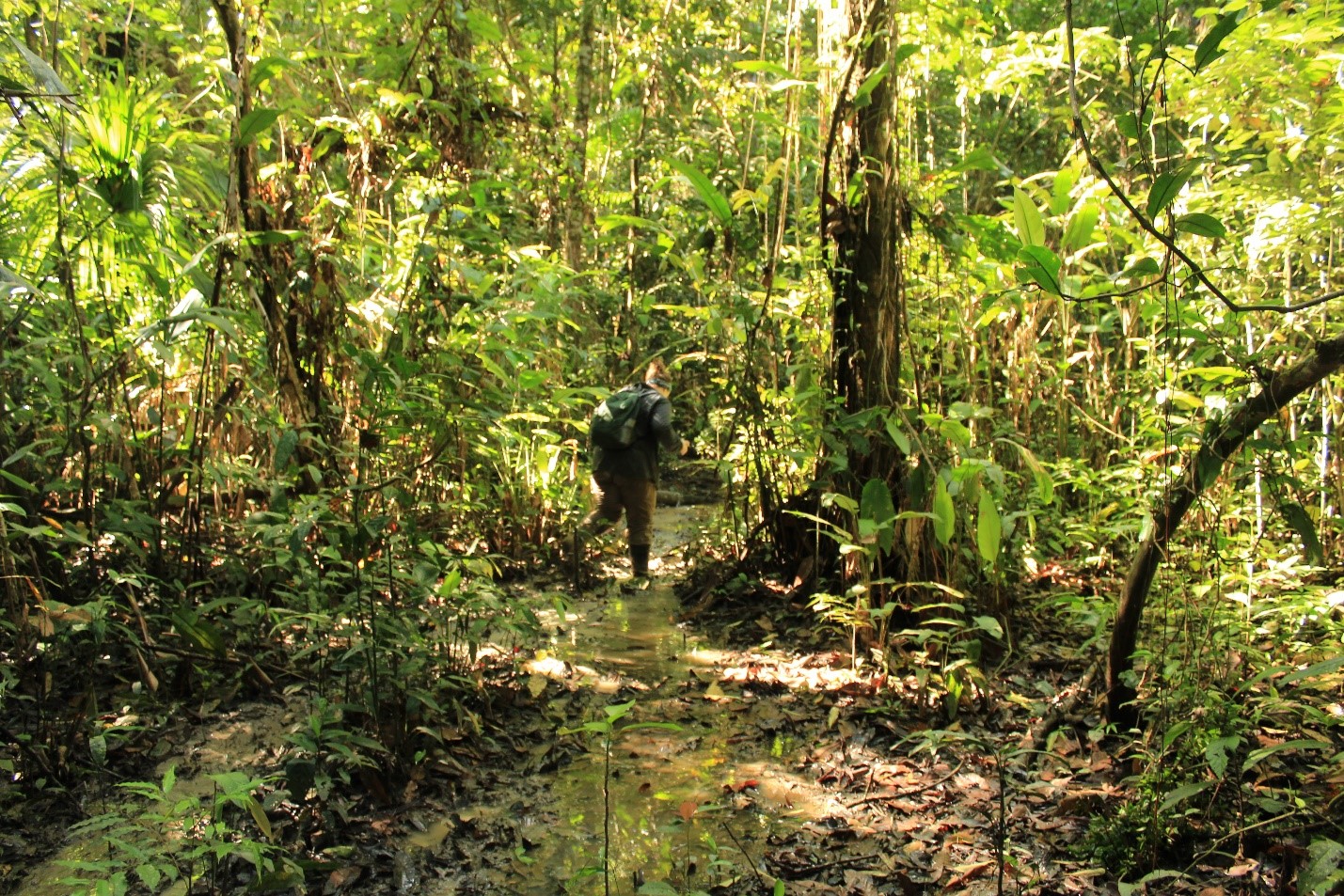
Six action-packed weeks were spent up-river altogether, splitting our time between each community. As before, each day involved squelching out into the surrounding wetlands. Our goal was to learn more about the types of forests that the community uses or in some way interacts with, and what the belowground environment and aboveground ecology was in each location. We were guided to areas of importance (appropriate for surveying) by a community member, seeming to effortlessly navigate the sucking swamps. Meanwhile, we would stop to tip out the sloshing aquarium in our wellies every few hundred metres! If our community guide told us it would take 30 minutes to get to a certain site, we knew it would take us double that, minimum.

20191114_121853

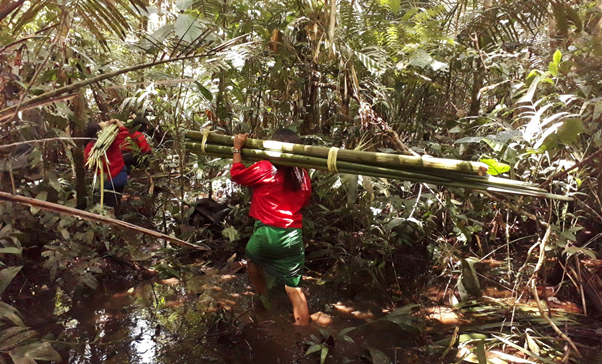
Some of the incredibly strong women in Nueva Pandora, who were carrying kilos of palm shoots that they’d just harvested in the leach-infested swamps, back to their homes 30+ minutes away, without wellies. We stood and watching in awe as we set up a plot, in wellies.

Each location contributed a new angle to the story of lowland peatland development and ecology in the Peruvian Amazon and gave us food for thought on how people use this challenging landscape. Each location also yielded a novel short-term challenge, whether it be swarms of incessant bees, mosquitos who pay no attention to clothing or repellent, thigh-deep water, buckets of water being poured down from the heavens, snake super-highways, or ants who somehow turn up in your pants. Character-building at best; madness-inducing at worst. To my surprise, I left the jungle this time with a new love of the Amazon and its many wonders.

20191129_142807

Bees – many and everywhere.

With the majority of the fieldwork now complete, it’s time to find out exactly what’s inside the many bags of samples that we brought back with us (peat or organic matter-rich mineral soil?) and explore the ecological and social survey data we collected. One major goal of the project is to produce a cohesive output that combines the quantitative ecological data with the qualitative social survey data, which will tell the story of the local value of the variety of wetland ecosystems in the PMFB. This will be a challenge, as is often the case in interdisciplinary work, but one that we are primed for.

Another major goal is to return to each community with the relevant results of our study and of the interactive studies that community members are carrying out with ODK, in order to enrich their knowledge, where relevant, and thus capacity to manage their relations to their environment, the people they interact with and the State.

And of course, we have to return to defend our title on the football pitch. And to find Paddington.

IMG_6443

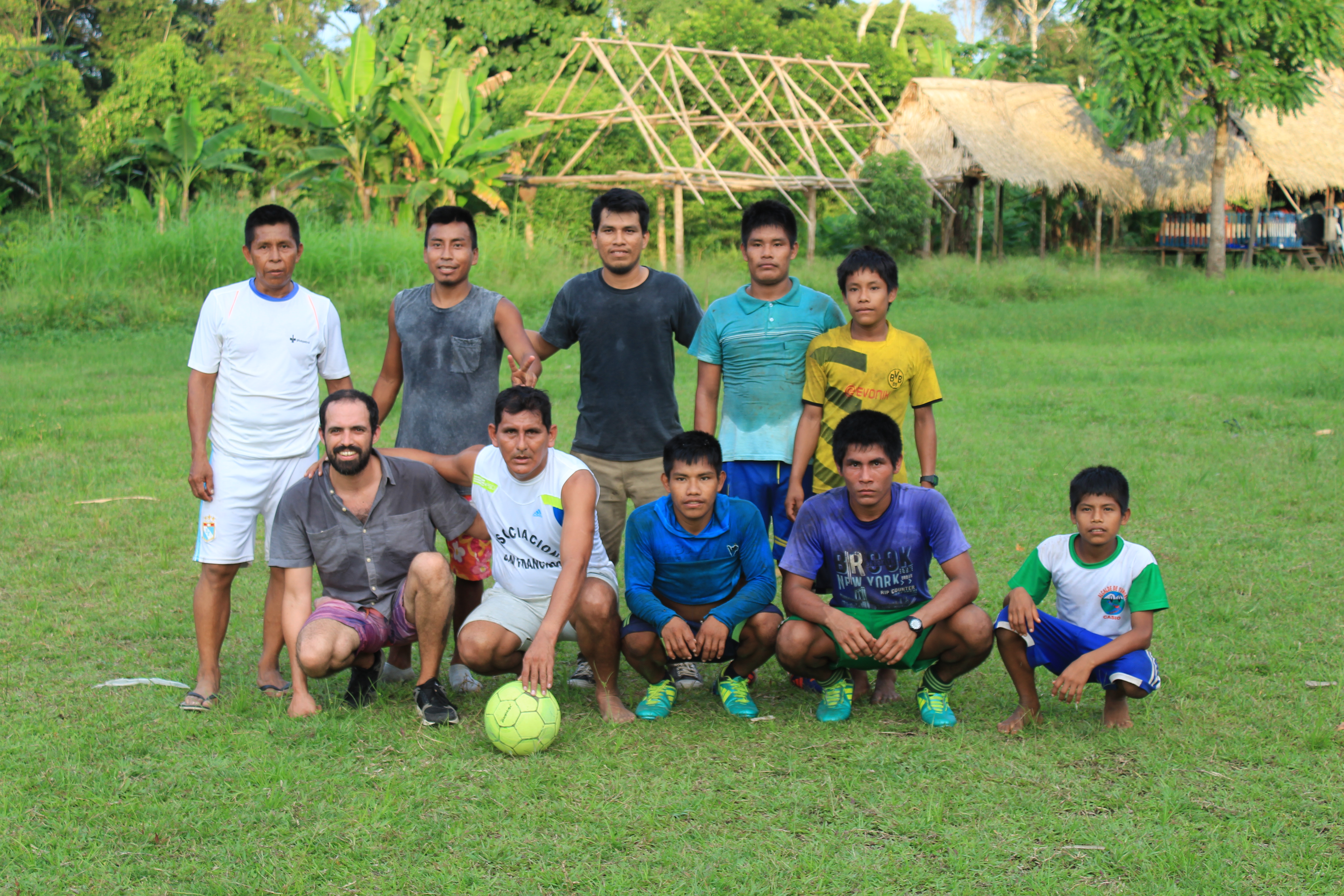
Our visiting Jiiri team posing with Nueva Pandora’s home team, the Leuuakus, after a long football match (and a long day in the swamp!). I am indebted too all of these people for their help and kindness over many days in the jungle.

Sucked in (to the swamps)

About a month ago, I got back from my first ever trip to the continent of South America.  And the reason for my visit?  Peat, of course.  Here is a blog post I wrote for my new(ish) research group, the Tropical Wetlands Consortium, on my recent adventure to the “chupaderas”, or sucking swamps, of the western Amazon. 

Anna_aguajal

A colleague, being sucked in.  (She is entering a type of palm swamp dominated by Mauritia flexuosa, locally known as an aguajál and important for the fruit that can be harvested there.)

At the end of June, I got back from two months of fieldwork in the Peruvian Amazon.  The swamps, the Amazon, Peru, and indeed South America, were all new to me, having spent most of my research career to date searching for remnants of intact peatlands in Southeast Asia.

In the Pastaza-Maranon Foreland Basin (PMFB), a large area of the lowland Amazon within the Department of Loreto, Peru, you’re pushed to find any land that isn’t swampy to walk on.  Mapping projects to date have estimated the peatlands of the PMFB to cover 100,000km2.  One of the reasons I was there, along with six colleagues (from the Universities of St Andrews, Edinburgh and Manchester) and a bunch of exceptional assistants, was to help improve the accuracy of this estimate.  We each had slightly different data gathering agendas, but overall were trying to find out more about the evolution, ecology, condition and value of these peatlands, both from a local and global perspective.

Dael_Veinte

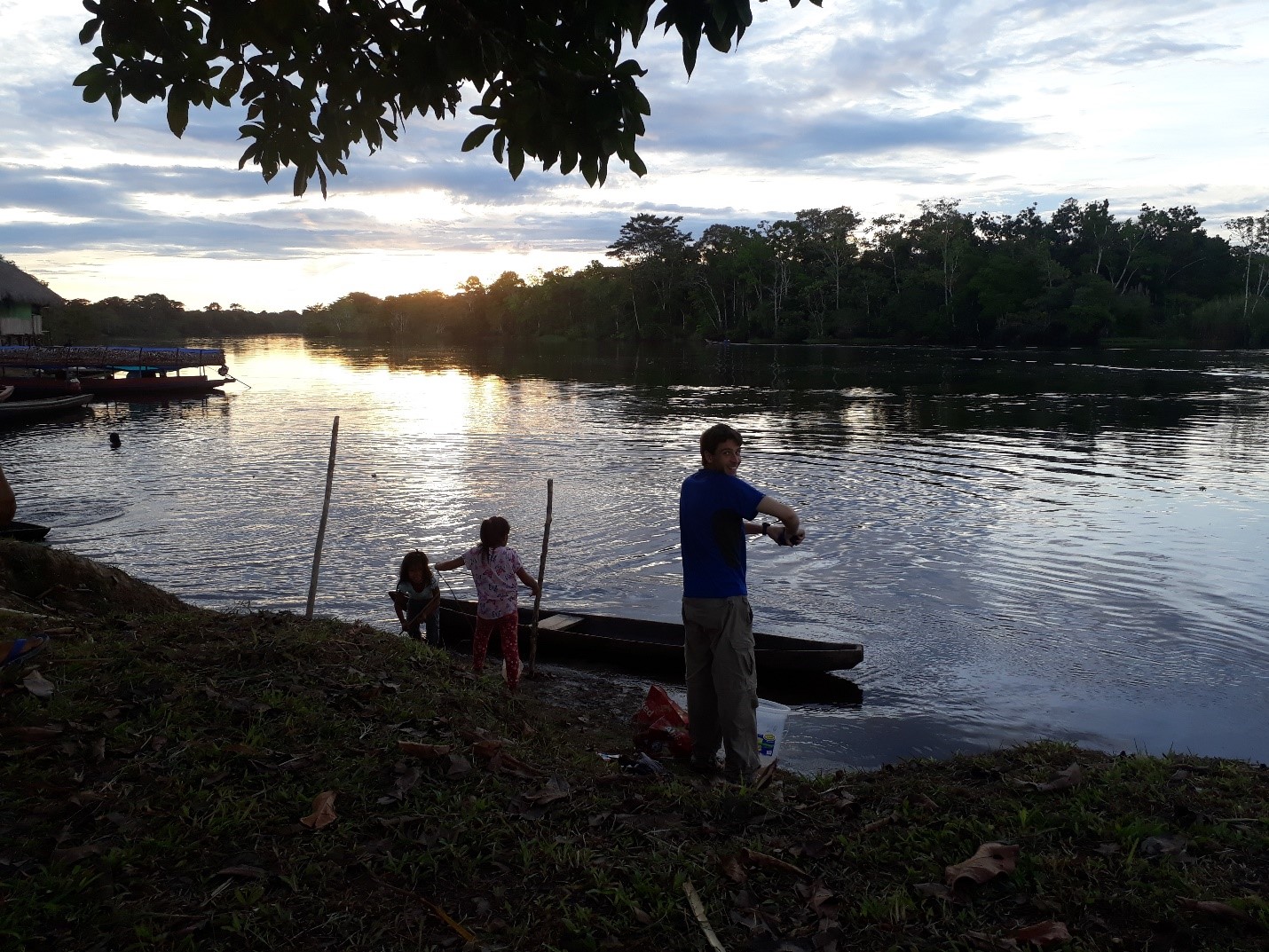
Washing clothes in Veinte de Enero, on the banks of the Yanayacu river, on one of the many fine evenings after coming back from a sweaty day in the swamps.

My focus, along with that of Luis Andueza (fellow St Andrean) and Charlotte Wheeler (Edinburgh), was to investigate how people value the wetland ecosystems of the PMFB.  Luis formed a key part of the social science team, made up of a great bunch of co-investigators and assistants from the Instituto de Investigaciones de la Amazonía Peruana (IIAP).  They spent many hours asking many questions of the members of three communities, Veinte de Enero, Nueva Union and Nueva Pandora, living on the banks of the Yanayacu, Chambira and Tigrillo rivers, respectively.  They, incidentally, drank a variety of liquids during the interviews, to facilitate their social integration with the communities!

Chambira_plot

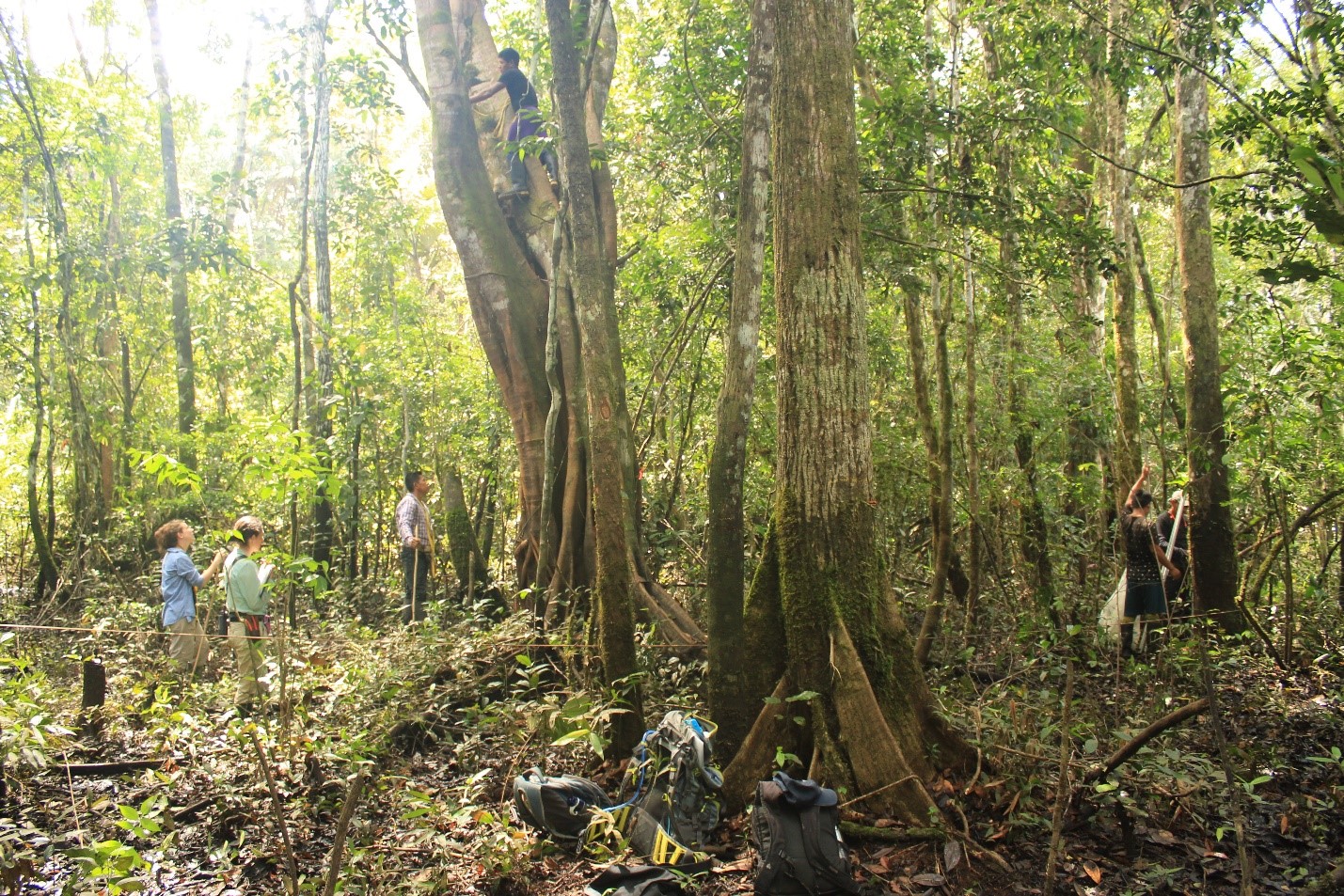
The ecological crew I was with, busy measuring what we measure in a plot.  Spot the agile one up the tree.  Never have I seen such heights scaled so quickly, and with such ease!  (I might need to adapt the Risk Assessment for the next trip, however.)

Concurrently, Charlotte and myself, led by our brilliant botanist, Nállarett, and two courageous Field Assistants, Julio S and Julio I, were out exploring the many ecosystems that surrounded these communities.  Our work was, in essence, a big treasure hunt.  Our mission (that I questioned why I’d chosen to accept at various points of inundation!) was to find the gold – the code-word for peat.  We ventured into the environment surrounding the three communities in order to “ground-truth” information of two sorts: (i) ecosystem types/resource extraction locations marked on participatory maps generated by the communities in workshops run by the social science team, and (ii) maps generated through remote sensing (using Landsat imagery) that depict changes in land cover, with the different ‘covers’ yet to be confidently identified or understood from an ecological perspective.  We spent approximately 20 days cutting our way through swampy forests of all shapes and sizes.  When we came across a new ecosystem type, and felt that we could work at that location for two hours without sinking, we gathered data on various above- and below-ground characteristics.  One of the most challenging plots was half a meter under water, at a location aptly named “31 Devils”.  Thankfully, I’ve had previous experience of snorkelling in bogs.

Now that we’re all back on solid ground, we’re starting to explore all of the ecological and interview data collected from the swamps, to try to understand how people use, and importantly, how they value the wetlands ecosystems of the PMFB, as well as understanding the physical characteristics of these ecosystems from a western scientific perspective.  Our initial findings suggest that there are a whole range of forested wetlands used by these communities, composed of a huge diversity of flora on both peat and non-peatlands, and on a confusing mix of peaty-lands in between.  And, not unsurprisingly, people tend to avoid the deeper, looser, more “sucking”, mosquito-ridden swamps, when and where they can!  Sensible folk.  But we still have much to learn about the nuances of how each community values these carbon-rich, biodiverse and beautiful ecosystems.

Whole_group_Veinte

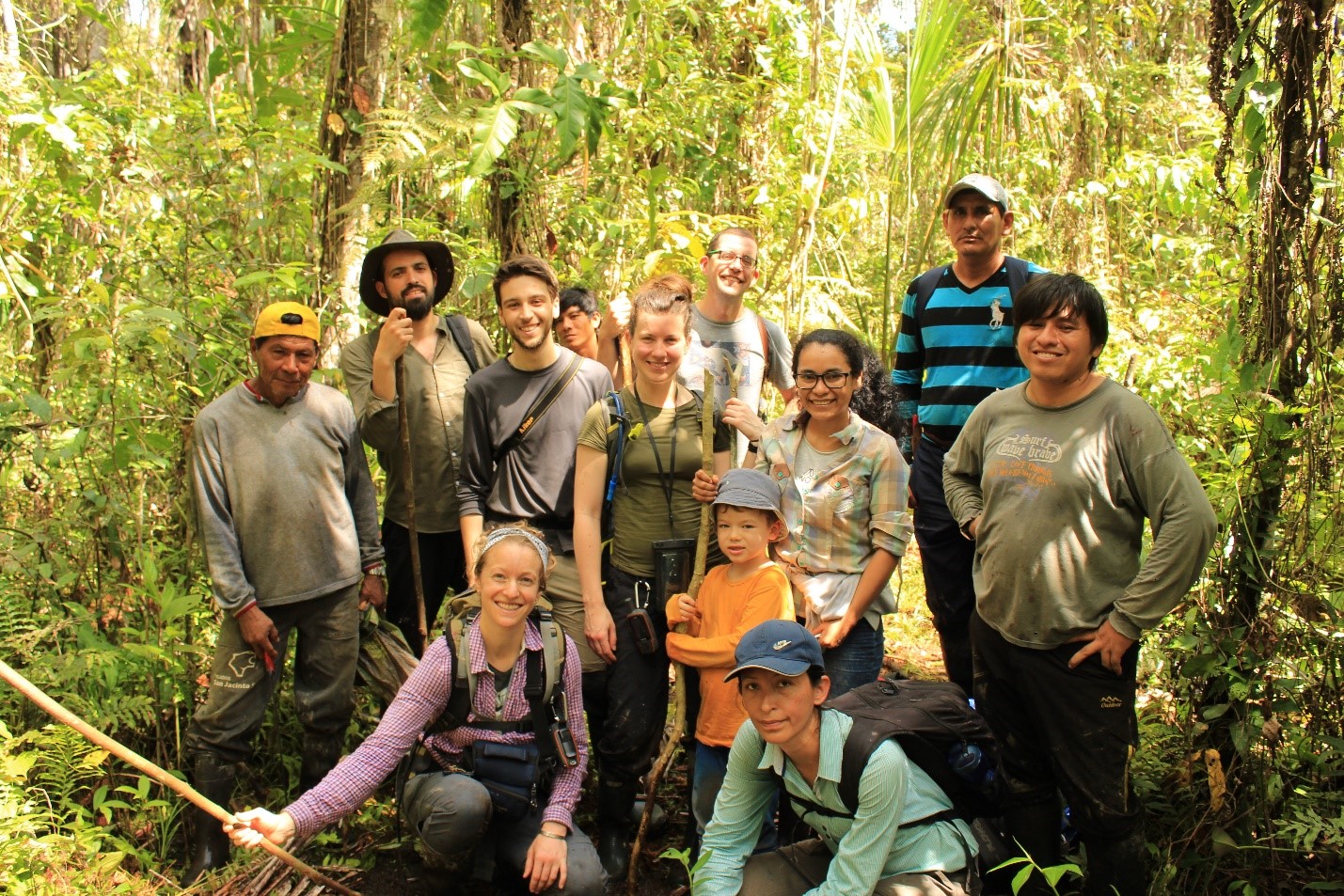
Some of the great team, fresh-faced and smiling at the start of our fieldwork campaign!  (One member of the team may have been carried over the swamps in some parts.  Many other members of the team wished someone would carry them over the swamps in all parts.


Las turberas de Peru

I learnt a new word this week: turberas.  In about three weeks’ time, I’ll be off to Peru’s turberas.  In case you hadn’t guessed, turberas = peat.  My new gig is on a project entitled Valuing Intact Tropical Peatlands.  I’ll be heading out to Iquitos, a city (inaccessible by road – for better or for worse) within the Peruvian Amazon, which will be the base from where a crew of us researchers will be heading into the swamp forests this side of the Andes.

20190402_121603

Talking shop with the team, at the edge of a bog.

There are still a fair few questions to answer on the exact details of the research and the associated fieldwork that we will be doing, but we made huge head-way this week at our first project meeting.  We were fortunate to have four of our Peru-based colleagues join us (all from the Instituto de Investigaciones Amazonía Peruana) for three and a half days of intense discussions.  And my, it was frazzling.  (I have a new-found respect for the MPs of the UK Parliament after two+ years of what have effectively been intense interdisciplinary discussions.)  This project is the first truly interdisciplinary one I’ve been a part of, i.e. much more than just lip-service is being given to the notion of working together, across disciplines, to answer some multifaceted questions.  I’m re-learning the importance of patience, open-mindedness, clarity, humility and perspective: all immensely valuable skills for any project, and any well-lived life.

I will write more about the project as the days fly by, but at this point, one of the persisting aspects of it (whilst others seem to come and go with the wind!) is that we’re interested in finding out how and why people are interacting with their environment, notably the boggy bits of it.  For me, it’s such an exciting project, and certainly as interesting as it is challenging.  And it’s such a privilege to work with a team of passionate Peruvians, and an engaged UK-based crew, spanning the social and natural sciences.

Watch this space for more reflections on working interdisciplinarily (a word? – probably in the social sciences), and for news on how I fare in a real-life intact peat swamp.  A rare and wonderful space these days.

Time for tea in Java (Part II)

This blog post forms part two of two pieces I wrote for the Condatis News Blog, describing my recent trip to Southeast Asia as part of my role (Knowledge Exchange Assistant and Landscape Analyst) at the University of Liverpool, working under Dr. Jenny Hodgson. We spent three weeks in Malaysia and Indonesia, as a component of the 11 month NERC-funded Innovation Follow-on project: Decision support for restoring ecological networks in rapidly developing, biodiverse countries. The first blog post can be found here.

20180718_112346

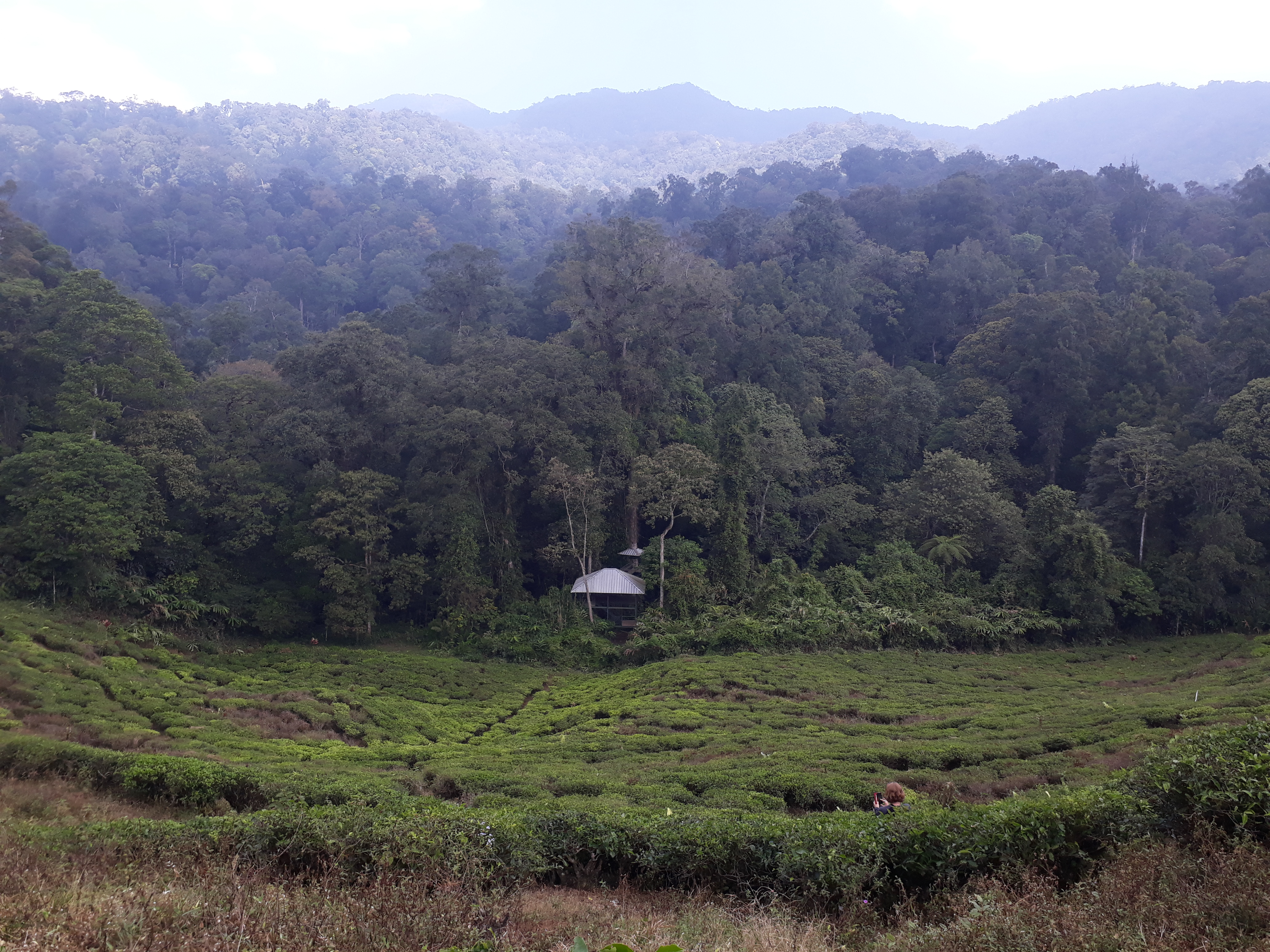
The edge of the rainforest bordered by a tea plantation, within Mount Halimun Salak National Park, West Java, Indonesia.

We flew south over the forests, mountains and oil palm plantations of Borneo and landed in the recently modernised Soekarno-Hatta International Airport, retrieved Jane Hill and headed straight to Bogor, taking care to avoid Jakarta – the city of impenetrable traffic jams! We had the pleasure of staying a few minutes’ walk (and a treacherous road crossing) from Bogor’s Botanic Garden (Kebun Raya Bogor), an 87 hectare forested landscape in the middle of a city of one million residents, set up through a Dutch-British botanical collaboration in 1817. Definitely worth a visit!

The next morning we met with our main project partner for the Indonesian component of our project, Dr Lilik Budi Prasetyo, the Head of the Environmental Analysis & Spatial Modelling Lab. at Bogor Agricultural University (Institut Pertanian Bogor) and our other chief contacts, including Erlan Sodahlan, the Community Engagement Officer of Halimun Salak National Park. These two gentlemen guided us over the following three days, and were so patient in answering an almost continuous stream of questions from us interested and unacquainted British tourists!

After hearing about the exciting work that Lilik and his team are doing around improving the accuracy of remote classifying forest land cover in Indonesia, Jenny gave some background to Condatis and our collaborative project. Then it was time to head into the landscape in question: the Mount Halimun Salak National Park (Taman Nasional Gunung Halimun Salak, TNGHS).

20180716_152817

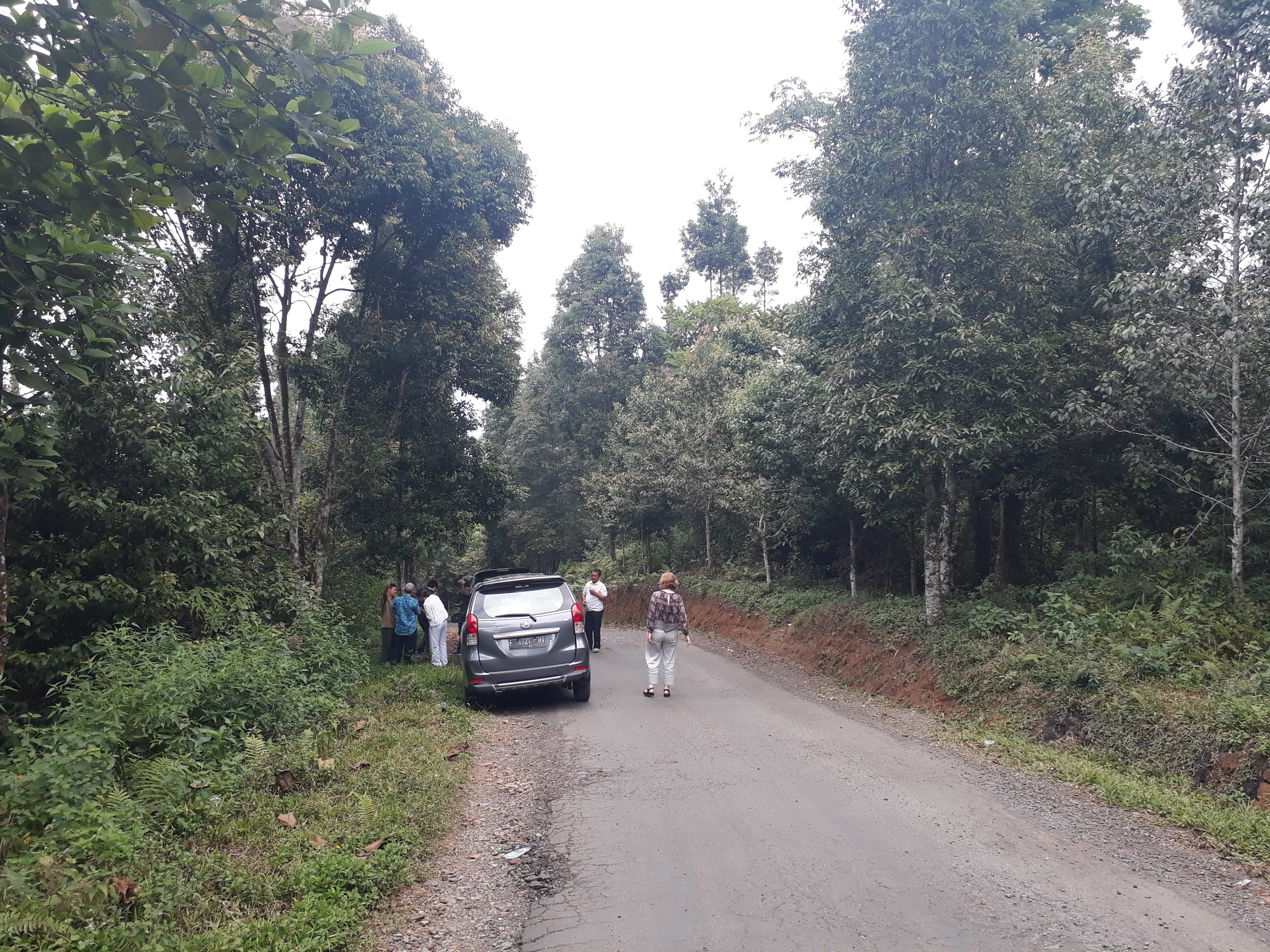
Our party stopped to view the wildlife corridor we are proposing to model using Condatis, between Mount Halimun and Mount Salak, within the National Park. (Note the road – a modern feature of most “wildlife” corridors!)

We observed a complex, fascinating landscape as we drove through, with a mix of expertly terraced rice paddy, small vegetable plots, perched hamlets on the edges of small, steep valleys, all with the backdrop of Mounts Halimun and Salak. Beautiful and interesting to look at, but far from a natural environment with only small patches of forest remaining outside of the Park. Much like all of the UK! Inside the Core Zone, there remains one of the largest continuous tracts of tropical forest in Java, and it is intact due to strict protection. Outside of this zone, there is a complex mosaic of human-modified landscapes, with degraded forest in between tea plantations, hydrothermal electricity plants and football pitches. Erlan and the National Park staff talked to us about how they are working with individual communities to develop village-specific Memorandums of Understanding on responsible use strategies and to make decisions on where to establish collaborative forest restoration projects.

IMG-20180719-WA0000

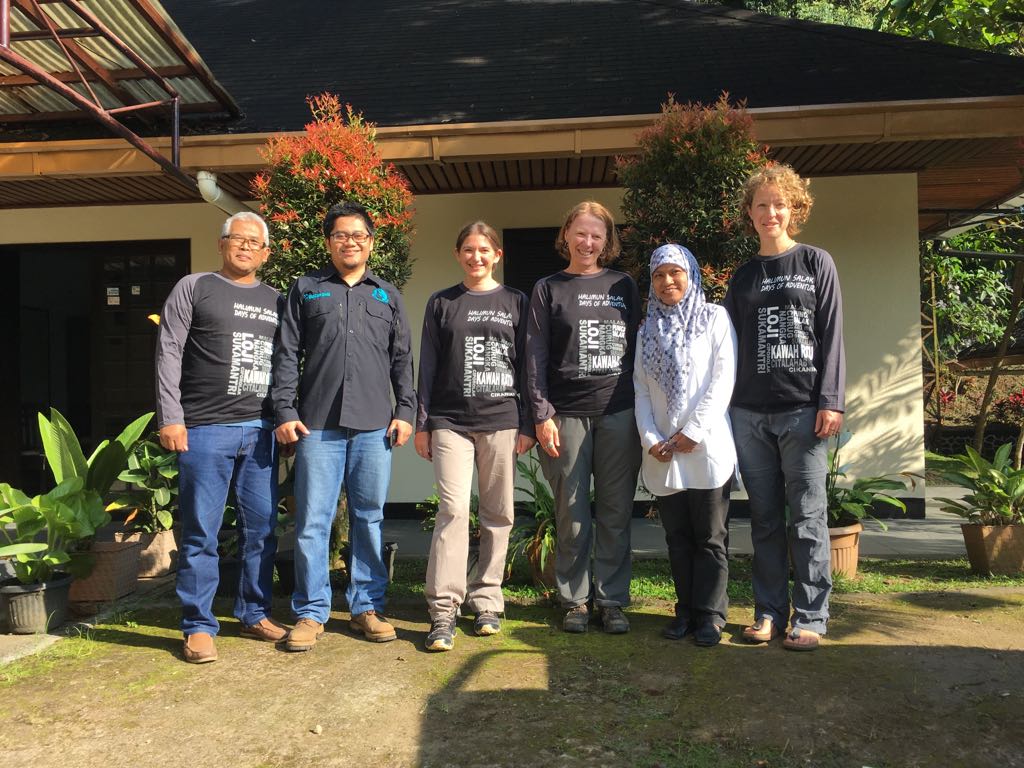
The Indonesia Condatis team outside the Taman Nasional Gunung Halimun Salak (TNGHS) Offices: Lilik, Erlan, Jenny, Jane, Pairah and me. (Photo credit: Jenny Hodgson.)

During our stay at the TNGHS Headquarters, we carried out a one-day workshop on Condatis for ten staff members of the National Park. The morning was spent introducing participants to Condatis and allowing everyone to have a go at their own analyses; the afternoon involved a discussion around the case study we are performing in their landscape. Through some lively discussions (mostly in Bahasa Indonesia!) we gathered useful feedback on the key species of interest and major conservation challenges. We are hopeful that Condatis will generate maps which will highlight priority areas for forest restoration in and around TNGHS’s corridors. We had a fascinating few days learning about another tropical forested landscape, which shares broad similarities with Sabah and important subtle differences.

Three action-packed weeks later we returned to the UK, bringing the tropical temperatures with us it seemed! Now it’s time to process all of the information we gathered on our travels across the islands of Borneo and Java, to develop our plan of work in TNGHS and to make any refinements to the Condatis layers contributing to the Sabah connectivity project. We thank everyone who made our trip so exciting, so interesting and fed us such yummy food!

Business cards, butterflies and boats in Borneo (Part I)

This blog post forms part one of two pieces I wrote for the Condatis News Blog, describing my recent trip to Southeast Asia as part of my role (Knowledge Exchange Assistant and Landscape Analyst) at the University of Liverpool, working under Dr. Jenny Hodgson. We spent three weeks in Malaysia and Indonesia, as a component of the 11 month NERC-funded Innovation Follow-on project: Decision support for restoring ecological networks in rapidly developing, biodiverse countries.

IMG_4723

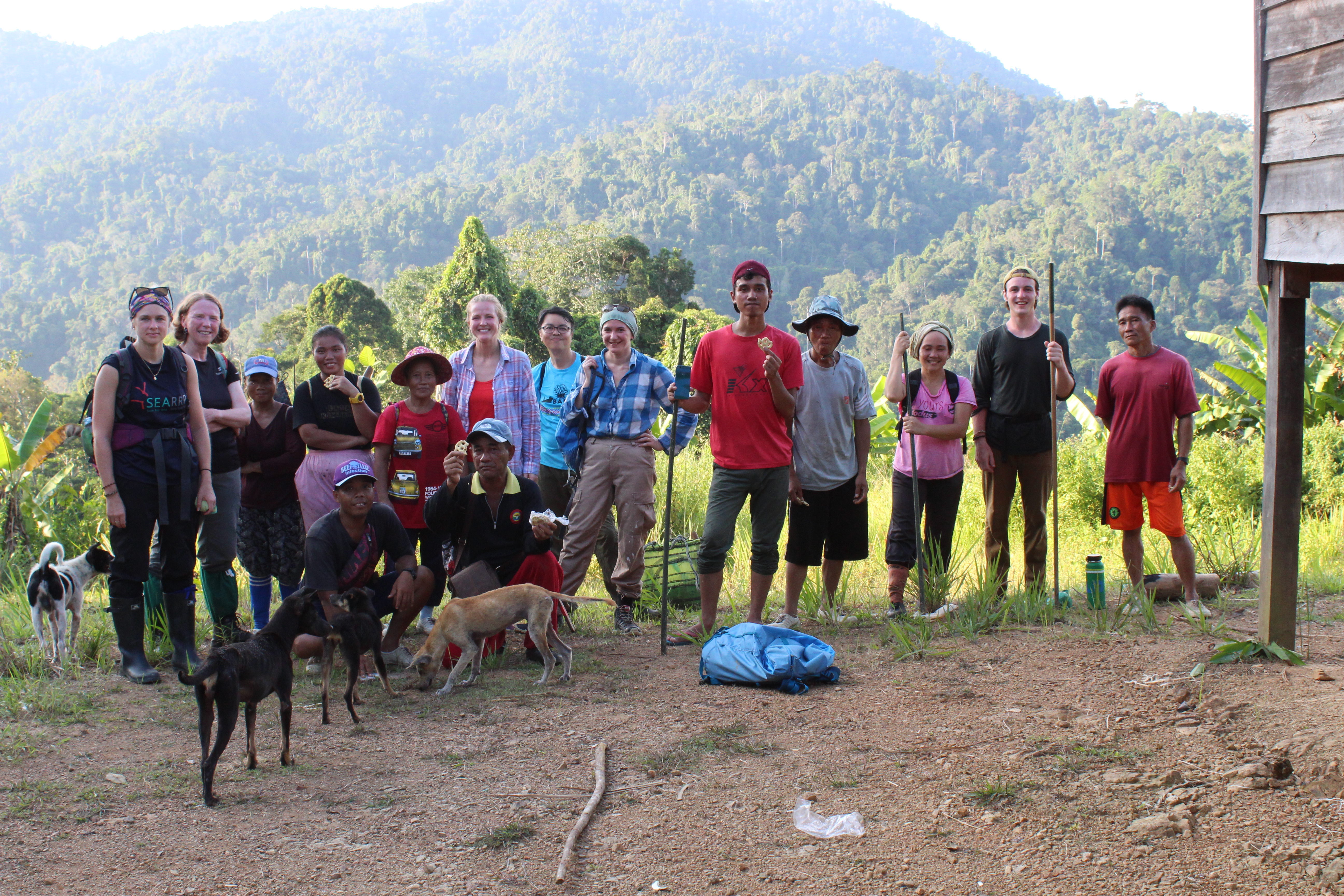
The kind residents of Kampung Sikalabaan, in Sabah’s Heart of Borneo region, showed us around their community forest and farmland for the day.

Whilst everyone was sweltering under abnormally tropical temperatures in the UK during July, Jenny and I were enjoying a relatively temperate time in the Tropics. We spent the majority of the month in Malaysia and Indonesia, visiting the partners and landscapes that are involved in our NERC-funded project: Decision support for restoring ecological networks in rapidly developing, biodiverse countries. Ghana is the other country involved in the project, which we had the privilege to visit back in April (reported on here). This time, road trip around Southeast Asia!

Our travels started with a stop-off in Kuching, Sarawak, to attend the Association of Tropical Biology and Conservation’s (ATBC) annual meeting, entitled Linking Natural History and the Conservation of Tomorrow’s Tropical Ecosystems. It was a fascinating five days, attended by a huge range of nationalities talking on a similarly wide variety of topics. Jenny presented on Condatis and I on the long-term ecology of tropical peatlands (another passion). Many of our collaborators were also there presenting, including: Professor Jane Hill and Dr Sarah Scriven from the University of York, and Dr Jed Brodie and Dr Sara Williams from the University of Montana. And we made some useful contacts for the Condatis project, as my new collection of business cards testifies.

20180711_142429 (1)

Jenny presenting the concepts of Condatis to the participants of our training workshop at Universiti Malaysia Sabah (UMS).

Just hours after the closing ceremony of the conference had finished (and the after party was likely still in full swing!), we flew on to Kota Kinabalu in Sabah, to attend a catch-up meeting for the Sabah-based project we are involved in. The meeting was organised by the Southeast Asian Rainforest Research Partnership (SEARRP), the charity that is coordinating this multi-stakeholder project. The other partners involved in this mapping project include the Universities of York, Aberdeen and Montana, Universiti Malaysia Sabah, the Carnegie Airborne Observatory and the PACOS Trust (an inspiring charity supporting indigenous communities in Sabah). We discussed the first set of outputs the group had developed for the project; generated using biodiversity and soils data, satellite imagery and modelling, including various layers derived through Condatis that have been incorporated into the prioritisation process. The next stage of the project will involve the PACOS Trust consulting with indigenous, forest-based communities on which of the areas highlighted through our ecological analysis, are appropriate for enhanced protection.

In order for us ecologists to understand the human-component of these forested landscapes, we were extremely fortunate to be invited to visit several different communities with PACOS. So the next morning, five of us, equipped with walking boots and mosquito nets, headed upstream, into the Heart of Borneo.

IMG_4486

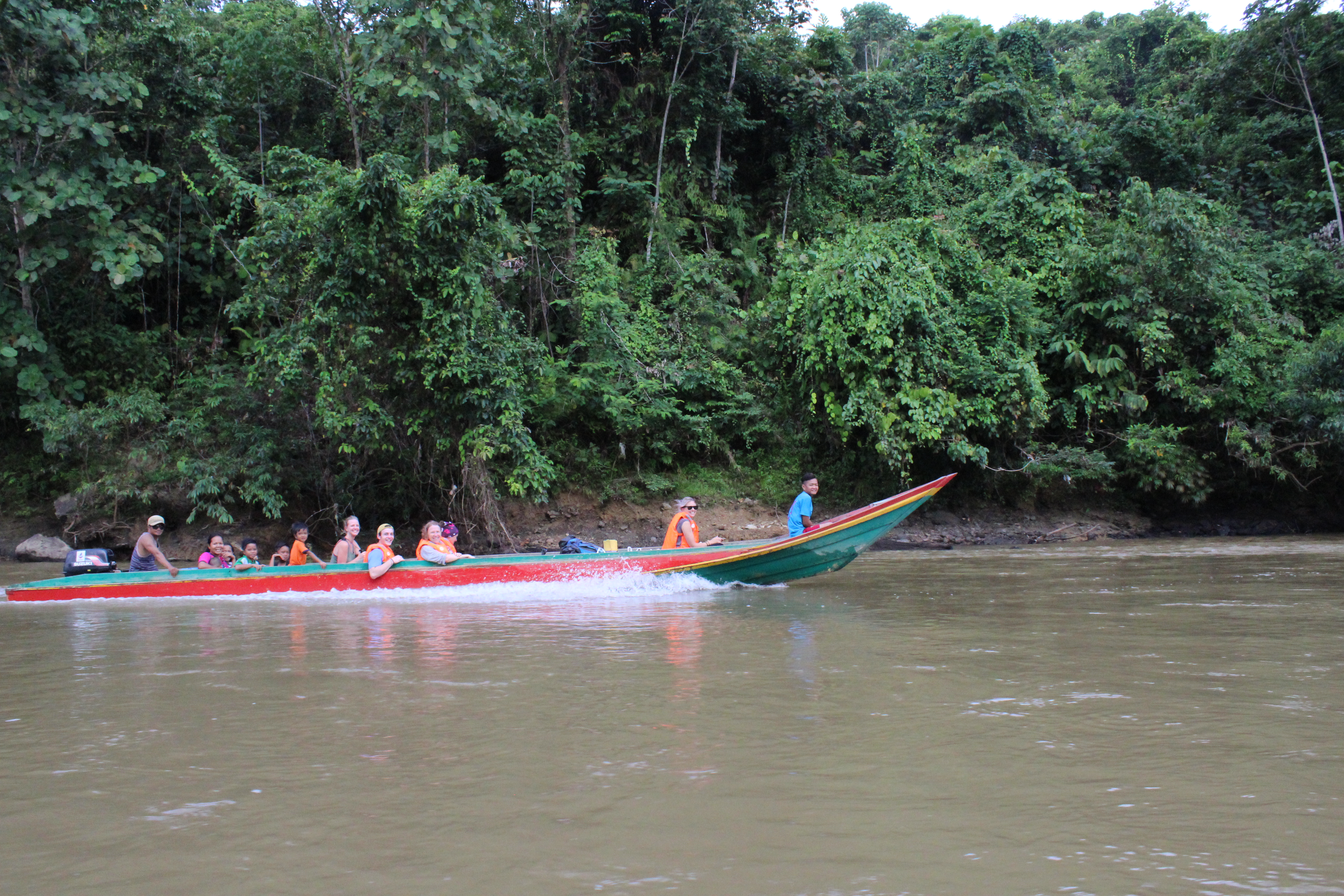
Travelling by boat to the village (kampung) of Sikalabaan, about two hours up-river from Kampung Salong, where the road ends.

We spent three nights in the “cultural house” of Kampung Sikalabaan, along with a dozen other men and boys who were visiting in order to attend training on how to fix boat motors, organised by PACOS. These communities rely on mechanised boats to travel between villages, to school, to obtain provisions and to generate an income; with replacement parts for engines being so expensive, it is important that people know how to fix them. PACOS offers training courses for members of indigenous communities across Sabah, on subjects ranging from how to plant chilli peppers, fix broken machinery, to how to make soap, with the aim of improving their capacity to sustain a low-impact livelihood in the often remote locations they occupy.

We spent one incredible day observing how members of Kampung Sikalabaan use their forest and its plethora of resources. Members of seven families led us patiently (we were significantly slower and less agile than them, despite the laden woven backpacks they were carrying!) through the jungle to their farms, laid out in forest clearings. Along the way, they stopped occasionally to harvest wild ginger or check on a small vegetable plot they’d established, apparently opportunistically, within their community land. Early afternoon, after walking upstream/in-stream for quite some time, we stopped for a spectacular picnic: out of their woven baskets, the women produced a feast for the twenty or so of us, with freshly boiled rice, freshly picked aubergine broth and then to top it off, they caught and we cooked freshly-netted fish from the flowing waters two feet away. Beats a Sainsbury’s sandwich.

It was a privilege to see how this community so expertly uses their land, and how important it is for them to have access to the forest and its resources. With rural-urban migration and the designation of ‘communal lands’ providing opportunities for the expansion of oil palm into these areas, as well as pressures on resources and disturbance to ecosystems from logging, industrial agriculture and mining, these community-owned lands are being compromised. The Government’s goal of expanding strictly protected areas across more of its forested asset adds another dimension to the challenge of maintaining indigenous communities in these landscapes. But more discussion on this complex issue will have to wait for a future blog! We thank PACOS and SEARRP (Gordon, Angie and Agnes in particular) for organising this insightful opportunity.

IMG_4630

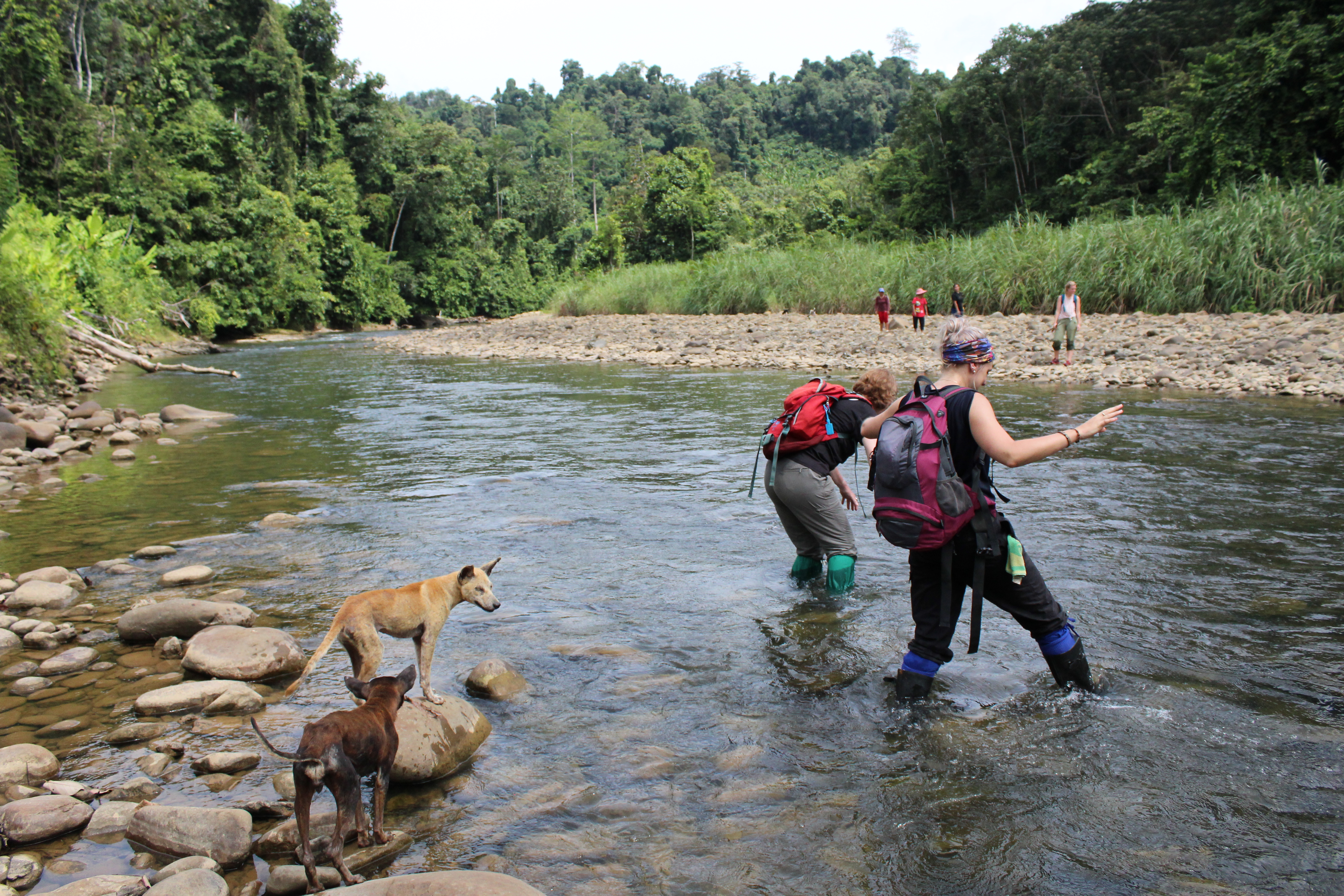
The first river crossing. We didn’t realise there were about a dozen more to come. Each time it was so refreshing to wade through thigh-deep water; a welcome relief from the tropical humidity. Thankfully my camera avoided any refreshing dips though!

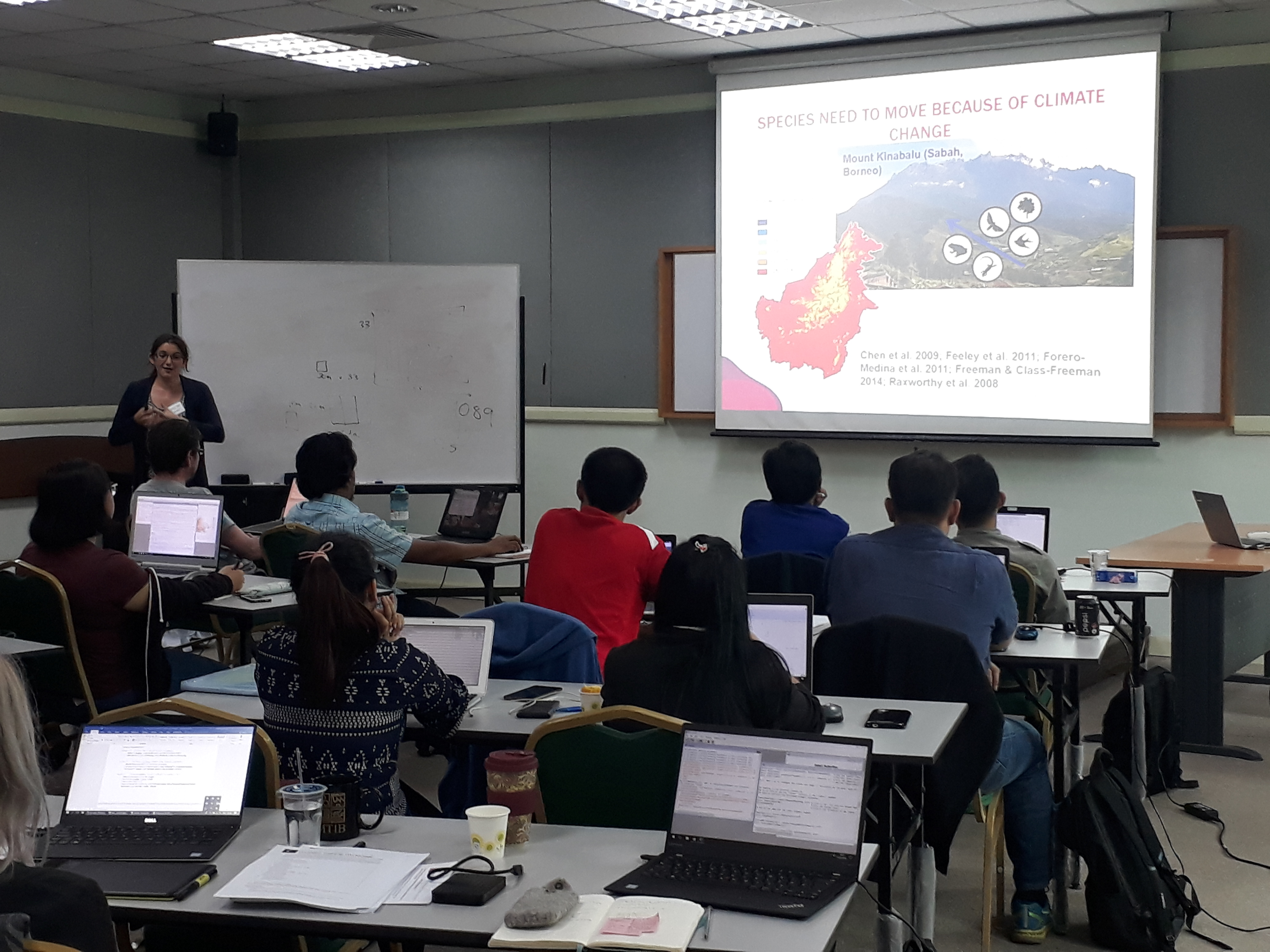
Leaving the forest and returning to Kota Kinabalu was a bit of a shock, though the washing machine was welcomed! The next day we headed into the Forestry Complex at the Universiti Malaysia Sabah (UMS) campus for two days of training. We had 20 participants attend from a range of backgrounds: in addition to UMS students and lecturers, people attended from the Departments of Agriculture, Irrigation and Drainage (JPS), Forestry (SFD) and Environment Protection (JPAS), from WWF-Malaysia and SEARRP. The first day was led by Dr Sarah Scriven and introduced participants to the R program and how to perform basic analysis and geospatial data processing. The second day, led by myself and Jenny, introduced the concept of Condatis, followed by an interactive session where we guided people through performing their own analyses using the new web version of the tool. (Butterflies (rama-rama in Malay) were used as the study organism; Jenny’s favourite!) Though we were a little optimistic as to how much material we wanted to cover in two days, it seemed to be a success: our participants provided positive and useful feedback that we used to improve and refine our training workshop the following week in Indonesia.

With our fascinating range of meetings and field trips complete in Malaysia, we headed for the next stop-off: the island of Java.

~

For the second episode in our Southeast Asian adventure, click here or check out the next post.  

The Three Ps in Parliament

Before I turn off David Dimbleby (and his tie) and go to bed, and momentarily lie in peace before the reality of our next government unravels, I thought I would post this video of an event I attended to prior to our last general election, back in March 2015.  The British Ecological Society gathered a pomp of politicians in one room to debate on the topic of People, Politics and the Planet.

It was an interested few hours, obviously.  Planet did feature, but further down the list to where I, and my fellow ecologist friends in the audience would have liked.  Since then though, people have become a much more significant part of UK politics.  And if we don’t respect people, how can we expect them to respect the environment?  At least until our own back yards collapse that is (if we’re lucky enough to have a back yard).  But that’s another blog/dinner party discussion.

I was fortunate enough to be involved in the debate: at 50 mins in Part 2, the great Jonathan Dimbleby (what brothers, eh!) invited me to ask the following question:

“If you were all 20 again, and knew that you would be in politics for 40 years without the pressure of being elected out, what bold decision would you make that would actually make a sustainable contribution to the future of the planet?”

I wasn’t hugely inspired by the responses.  But I enjoyed being thought of as a millenial!

Part 1 can be viewed here.  Overall, it was a very interesting discussion that gave us plenty of fodder to last a couple of post-event pints.  Unfortunately I don’t think there was time to organise a similar debate before today’s election.  Or possibly any political interest?  But the issues are still there, and even more so.  Can we continue to push for ‘growth’?  What are the alternatives?  When will environment feature more centrally in manifesto chat (except, of course, amongst the great Greens)?  Will it just be the United(?) States that pulls out of the Paris Agreement?

Hmmm….. Bed time for bozoes.