Peatlands & private finance: recipe for …?!

In late summer of 2022, myself and my wonderful frolleague, Dr Conny Helmcke, were awarded funding to work on an interdisciplinary project with the broad remit of exploring how communities in rural Scotland are making decisions about whether, why and how to restore peatlands. I thought Conny’s work on environmental justice-related themes was very cool and wanted to learn from her, so approached her to see if we could work together. A few months later, we were awarded some funds from the University of St Andrews (with thanks!) to hire a research assistant, who could collect data to explore this theme (Conny and me being ‘tied up’ with teaching). We are ever grateful to Ewan Jenkins for doing such a fantastic job of building the relationships and understanding central to the success of this project, and in the depths of a Hebridean winter.

The main output of the project, as outlined below, is a set of online (and print, on request) resources for the crofting communities that we worked with in rural Scotland. We have also published a Correspondence piece in Nature (with an open access draft here) and an article for The Conversation. And back in March of 2024, as a result of submitting evidence to a formal call, I was invited to attend the 12th Meeting of the Scottish Parliament’s Committee on Net Zero, Energy and Transport, as an invited witness to give evidence on the opportunities and impacts of natural capital finance in the Scottish context. The first set of witnesses (principally representing private landowners across Scotland) focused on the importance of private finance (and the importance of derisking private finance using public funds) for nature restoration and the achievement of net zero goals/climate change mitigation; the second set of witnesses (from Community Land Scotland, Scottish Wildlife Trust, and researchers, including me) focused on the current challenges of the focus on private finance for achieving these same goals. Here are some links to: the agenda for the session, our written evidence (Clerk Paper 1 – Annexe C), the recording of the session (starting at 10:48:00) and the Official Report. The experience was as interesting and enlightening (about the/our political process) as it was frustrating.

There are so many questions still to answer around how we can support peatland restoration whilst supporting communities, in the current climate of carbon markets, amongst other uncertainties. I hope this project doesn’t end here.

** 

To give some more information on the project and resources for communities, here is an article that I wrote for the International Peatland Society’s Peatlands International quarterly communication.

Peatland ACTION assisted restoration of peatlands underway in the north of Lewis, Outer Hebrides. (Credit: Lydia Cole)

If you’re a crofter in Scotland, wanting to restore the peatland ecosystems within your communal grazing land, how do you go about it? If you have the opportunity to take advantage of public funds so that restoration costs you nothing, should you take it? Or should you agree to sell the carbon locked up in your newly restored peatland to a company or a broker, to provide you with extra revenue and them with credits to offset their emissions? What are the costs and benefits of different pathways to restoration? And how might you gain, or lose, from peatland restoration itself?

In October of 2023, colleagues and I launched an online set of resources designed to answer these questions for crofting communities living in rural Scotland, to assist them in making decisions about how to navigate peatland restoration. (Crofters are individuals who have tenure or use of a small plot of land, i.e., a croft, traditionally in the Highlands and Islands of Scotland, where commonly part of their income is obtained from farming that croft and a larger area of communal land to which they have rights to graze animals.) The website housing these resources: Peatland Restoration: A Guide for Crofting Communities, contains a downloadable Executive Summary and extended Booklet outlining some of the key considerations for crofting communities embarking on, or under pressure to engage in peatland restoration activities. Alongside these, we provide responses to common questions that arose during a period of field research carried out in the spring of 2023 in Lewis, Outer Hebrides, in the form of FAQ, as well as a glossary of terms, to facilitate understanding of the unfamiliar words and complex phrasings common in discussions around carbon credits and associated carbon markets. All of these resources (bar the FAQ) are available in English and Gáidhlig (Scots Gaelic), reflecting the languages spoken in the communities they have been designed for.

These crofter-facing guidance materials are the result of a nine-month project funded by the St Andrews Interdisciplinary Research Support scheme, awarded from the University of St Andrews, Scotland. The research underpinning the resources was carried out by a team from the University of St Andrews, led by myself and Dr Cornelia Helmcke, with Ewan Jenkins employed as a Research Fellow, and Dr Bobby Macaulay, (coordinator of the Community Landownership Academic Network (CLAN), University of the Highlands and Islands) and Drs Shona Jenkins and Milinda Banarjee (University of St Andrews), as Co-Investigators. At project inception, Cornelia and I engaged various people to understand if our research questions were pertinent and could yield information of use in the development of informed policies on peatland restoration in rural Scotland. Bobby Macaulay provided invaluable feedback on our ideas and contacts for the project, one of which was the Peatland ACTION Officer in Lewis, Ben Inglis-Grant. We thank him for the time and wisdom he shared with us over the full course of the project. Peatland ACTION is the government scheme that funds and provides logistical support for the restoration of peatlands in Scotland. Peatland ACTION is not to be confused with the Peatland Code, a UK Government-backed scheme that acts as a standard against which carbon credits resulting from peatland-based restoration projects can be verified, enabling them then to be sold on the domestic voluntary carbon market. Our project explored the challenges and opportunities associated with the different pathways to restoring peatland ecosystems within crofting communities in rural Scotland, in order to provide insights for what is necessarily a rapidly developing area of policy around natural capital markets and net zero accounting. For an important critique of the carbon market in the context of achieving net zero in the UK, pertinent to the drive for peatland carbon credits, we recommend Andy Wightman’s blog.

The website and associated resources are being disseminated to crofting communities and organisations, researchers and policy groups, and anyone who might be able to make use of the information to better understand what support and regulation is needed to help communities navigate the new potential to earn money from carbon held within, or in the case of peatlands, not emitted from landscapes if they are restored (i.e., avoided emissions if ‘Business as Usual’ scenarios continued). If you have feedback on the resources and/or would like physical copies of the Executive Summary or Booklet, please email peatlandguide@st-andrews.ac.uk.

Avoiding ‘helicopter science’ – first steps towards finding solutions

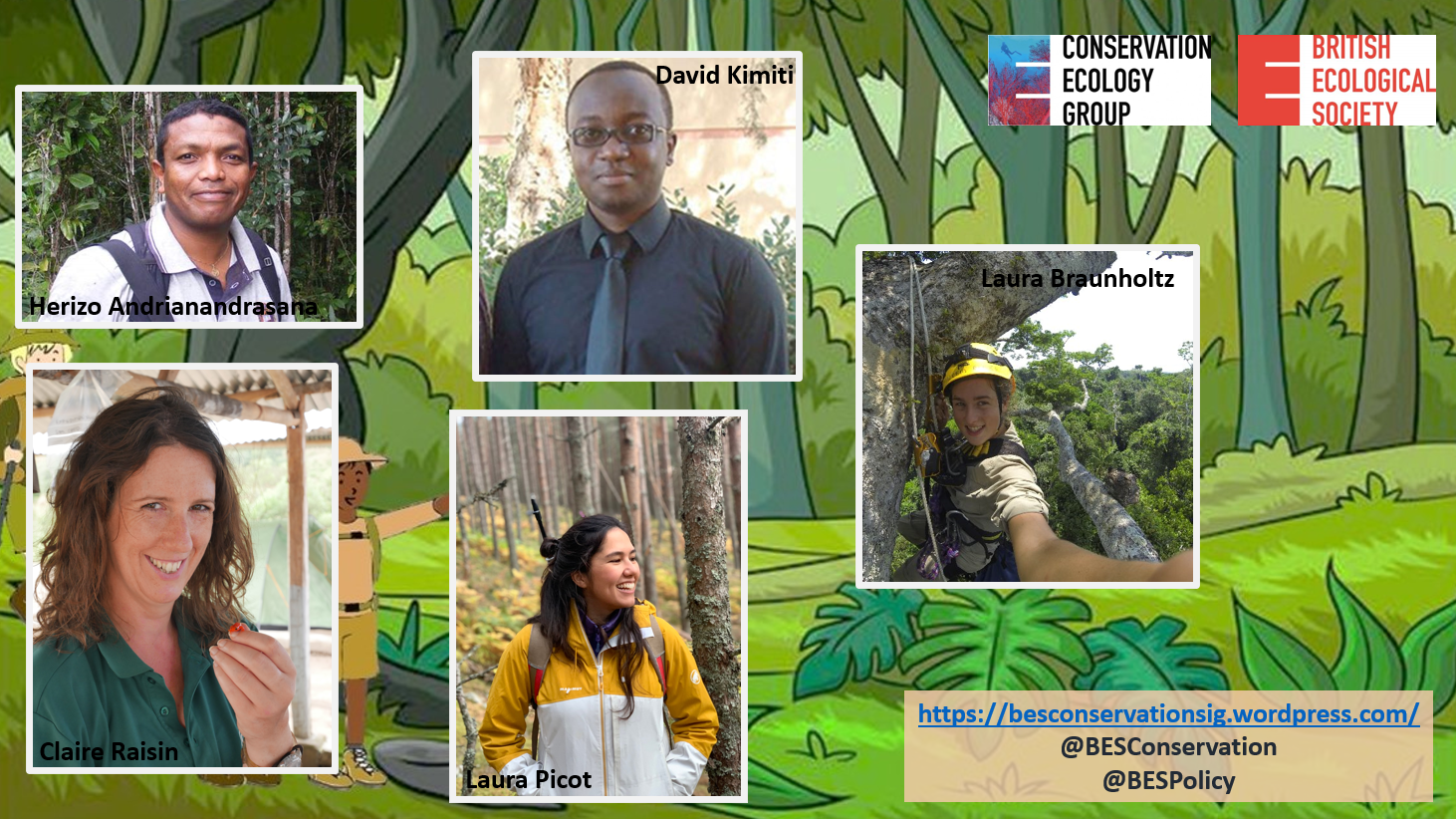
Back in March of 2023, I facilitated an online panel discussion on ‘helicopter science’: what it is, where it commonly arises, and how we might prevent it from happening. The event was hosted jointly by the Conservation Ecology Special Interest Group and Policy Team of the British Ecological Society (BES), after the two groups started to consider how they could better support equitable and inclusive ecological research happening across Majority (Global South) and Minority World (Global North) countries. The international panel (pictured below) kindly gave 90 minutes of their time to discuss this challenging topic. And we barely scratched the surface. If you’d like to read more about what we discussed, the Relational Thinking blog (associated with the journal, People and Nature) has just published our summary piece on the event. I will be co-running a workshop on the theme of equitable international fieldwork at the BES Annual Meeting in December, to provide an opportunity for more discussions, and to motivate action.

For Peatlands’ Sake

After many years in the planning, we have an exhibition in St Andrews all about peat. It even contains cores of peat extracted from down the road at Bankhead Moss and from across the Atlantic in the Peruvian Amazon. The exhibition is the brain-child/-bog of Katy Roucoux. She’s been working hard, alongside the Wardlaw Museum staff and a bunch of us peat-minded colleagues, for several years, to put together a room of stories about the ecosystems and people associated with the peatlands of Peru and Scotland, with reference to a splattering of other locations. It’s inspiring to see how research can be translated into a variety of interactive media, and how lush-looking walls of greenery can be created from plastic(!) (see image below).

The ‘lush’ green wall….

To accompany the exhibition, there are all sorts of events happening until the close on 7th May. One set of associated events are the Critical Conversations, where a small group of staff and students come together online to chat about a relevant topic. I was asked to chair a set of three conversations associated with the exhibition. Well, one to start with … and then somehow said yes to the set. (I’m not sure what happened to my resolution of saying yes less.)

In the first conversation, held on 20th February 2023, Katy Roucoux, Shona Jenkins and I discussed our thoughts in response to the question: can peat use be sustainable? We didn’t talk about the use of peat as a substrate in which to grow our tomatoes – a hot topic of discussion in UK policy circles at the moment – but focused on peatland use and whether that could be sustainable in the geographies which we are more familiar with: the Peruvian Amazon and Central Congo Basin. The answer is “yes”, but it depends. To find out about the circumstances under which the use of peatlands can be sustainable, have a listen to the podcast!

The second conversation, on 14th March, explored the multifaceted topic of ‘ethical’ fieldwork: what constitutes ethical fieldwork practices and how we might achieve them. Nina Laurie and Euridice Honorio shared their thoughts, developed through many decades of fieldwork in Peru and other locations, working alongside people with different life experiences, opportunities, and aspirations. Dennis del Castillo Torres, the Director of Forest Research at the Research Institute of the Peruvian Amazon (IIAP), also contributed some thoughts in a pre-recorded conversation that we (just about!) slotted into our live chat. It was interesting for me to have this conversation only one night after facilitating a panel discussion on how to avoid ‘helicopter’ science for the British Ecological Society (keep an eye on the Conservation Ecology blog for a summary article on that in the coming months).

The final Critical Conversation in For Peatland’s Sake trilogy, scheduled for 11th April, will ask whether museums can influence behavioural change. Answers on a postcard, please.

Although the two topics of the first and second Critical Conversations are nebulous, with the impossibility of reaching a one-size-fits-all answer, the conversationalists managed to articulate some really important points and provide plenty of food for thought, certainly for me. The gazillion £/€ question underlying all of the conversations is how do we achieve ‘real’ sustainability, and equity, in practice – where behaviours can continue indefinitely between passing generations – and generations of all people, across cultures, societies and social classes. Answering this question involves understanding how peatlands (in this case) function and what they need to be healthy, alongside understanding how we can nurture their good health whilst sharing out the gifts of these ecosystems amongst each member of our communities. Simple?! We’ll keep working on the answer.

The importance of being (inter)disciplined

Back in July 2022, I was invited to write a blog post for The Green Edge. This online fountain of ‘green’ knowledge was set up in early 2022 by Fraser Harper and Michael Cross, to explore and disseminate information about the skills the next generation* will need in order to navigate the pressing contemporary issues of mitigating and adapting to climate change, whilst simultaneously addressing societal injustices. I have had the pleasure of working with both of the founders of The Green Edge in the past, and am inspired by this new project that they’ve undertaken, with passion and impressive productivity. As well as their blog, they also now have a Podcast. I was grateful for the invitation to join their mission. My instruction from Fraser was to produce a post on a topic relevant to upskilling for ‘sustainable’ futures. I decided that my most useful contribution could be on skills required for effective interdisciplinary research; there’s not a chance we’ll achieve sustainability without working together.

Here’s the link to my post. Please get in touch if you have any comments on it. And if you have knowledge and wisdom to share on skills for green futures, Fraser and Michael would love to hear from you.

*and all of us!

I apologise for going ‘Green’

I published a paper earlier this month, all about peatlands in tropical latitudes. (Surprising, eh!) It proved an unexpectedly great opportunity to work with a new and interdisciplinary bunch of co-authors….

https://platform.twitter.com/widgets.js

And I created my first ‘thread‘! It seems to be what one does now to spread the word about new published research. My main incentive for tweeting, however, was to share the ‘personalised’ link I had been sent by the publisher, Elsevier, as corresponding author. Anyone interested can download the paper, for free, for the first 50 days post-publication. After that, the outcome of two years of information gathering by 10 people and many 1,000s of hours of publicly-funded research before that, will only be accessible to people from universities or other institutions that can afford the annual subscription to the journal, Anthropocene. Because this review paper had been unplanned when applications for research and dissemination funding were written, and was completed outside of one single research project, pooling time and resources from multiple people funded by multiple sources, we didn’t have the £2,000+ Article Publishing Charge to publish it via the Gold Open Access route. Instead, we opted for the shady back-alley route: Green Open Access. This means making the peer-reviewed, accepted version of our manuscript (the version accepted after the final review) available on our institutional website (e.g., here). I am certainly pleased that this is an option (after a 12-month embargo, it seems!*), but it does make finding the article an online adventure that time-poor academics and (often) under-resourced practitioners might opt out of. So for now, I apologise for not going for ‘gold’…

https://platform.twitter.com/widgets.js

And soon, perhaps we won’t all have to find pots of gold at the end of the rainbow to make new knowledge available (atleast in principle) to everyone.

*There’s an unhelpful loop-hole I just found out about, so here, legally, is the Author Accepted Version of the manuscript:

Cole, L.E.S., Åkesson, C.M., Hapsari, A.K., Hawthorne, D., Roucoux, K.H., Girkin, N.T., Cooper, H.V., Ledger, M.J., O’Reilly, P. & Thornton, S.A. (2022) Tropical peatlands in the anthropocene: Lessons from the past. Anthropocene. Author accepted manuscript.

A guide to building (interdisciplinary) bridges

Today, Althea Davies and I launched a guidebook. Nope, it’s not a guide to our local peatlands. It’s a Guide to Better Science on Interdisciplinary Research, published by the British Ecological Society and available to download for everyone, for free. We were invited to create the guide after running a workshop on tools of the interdisciplinary trade at the British Ecological Society Annual Meeting in 2019. Since then, we’ve been gathering information and contributions from some inspirational researchers, who reflect deeply on how to make interdisciplinary research (more) effective. We’re so grateful for their wise input, and for the guidance offered by Kate Harrison, the BES’ expert in-house Editor. I can’t fault my pretty great co-author either!

You can learn more about why we wrote the guide through our post on People and Nature’s Relational Thinking blog. And if you do read the guide, and find it useful…or lacking, we would love to hear.

From steaming swamp to blanket bog… We’re live!

After many more hours, and months of work than initially anticipated, our exhibition of Peruvian peatland pics is live. I sketched the article below with colleagues for publicity purposes; this press release adds a few more details. And the exhibition itself is available to everyone everywhere fortunate enough to have an internet connection: https://peatlands.wp.st-andrews.ac.uk/. Compiling the exhibition has very much been a team effort, with colleagues Katy Roucoux and Althea Davies. I’ve learnt a huge amount from their invaluable input and feedback on all aspects of this ‘outreach’ project. I hope we’ve created an accessible narrative that will inspire people to look twice at peatlands, temperate and tropical, and to consider what role they play in all of our lives. I’ve also learnt, the hard way, about the need to balance what can be a very diverse portfolio of work in academia, with publications still being the unit of currency and stamp of expertise for the (academic and employment) world. Now to learning how to achieve that balance before it’s too late…

An open peatland ecosystem in the Peruvian Amazon. Credit: Lydia Cole. To view the caption to accompany this image visit: https://peatlands.wp.st-andrews.ac.uk/.

This autumn, a touch of the tropical has come to southeast Scotland. From early August until late October, 2021, the St Andrews Botanic Gardens are hosting a photography exhibition all about Peru’s lowland tropical peatlands. Lydia Cole, Katy Roucoux and Althea Davies, lecturers from the School of Geography and Sustainable Development at the University of St Andrews, in collaboration with the Botanic Gardens and with funding from the British Ecological Society and The Leverhulme Trust, have curated a collection of photographs that take you on a tour of the steaming swamps of the Peruvian Amazon.

The selected photographs were taken by researchers from the Universities of St Andrews, Edinburgh and Leeds, and the Instituto de Investigaciones de la Amazonía Peruana (IIAP, Institute for Research on the Peruvian Amazon) across ten years of fieldwork in Peru’s peatlands. The exhibition explores three key themes: ecosystems – highlighting the “ecosystem engineers” responsible for carbon storage; fieldwork – describing experiences of data collection in the swamps; and people – illuminating the communities and activities associated with the peatlands.

In addition to the physical exhibition, a virtual gallery is housing the photographs and captions to provide online access to audiences near and far: www.peatlands.wp.st-andrews.ac.uk. The website is also available in Spanish and will be live beyond when the exhibition closes at the Botanic Gardens at the end of October 2021. When accessibility improves in Peru and COVID-cases stabilise, colleagues from IIAP plan to display a Spanish-language version of the exhibition in a National Reserve in the Amazonian region of Peru.

Peatlands are a distinctive type of ecosystem where the surface vegetation contributes to, and lives on top of, layers of accumulating peat. Peat is made up of leaves, roots and partially decomposed organic matter, which builds up when waterlogged, low-oxygen, low-nutrient conditions prevent decomposer organisms from recycling dead plant remains. Over hundreds to thousands of years, a thick layer of carbon-rich peat accumulates. With climate change a key challenge faced by global society, conserving the carbon stored in peatlands is becoming an international priority for mitigation efforts.

Peatlands make up over 20% of the land area in Scotland. The most common type of peatland is a blanket bog, where layers of peat carpet the bedrock, forming waterlogged, mossy and shrubby landscapes. In the Peruvian Amazon, peatlands look very different as they are generally forested and often flooded; they are the archetypal ‘swamp’. Over 80% of Scotland’s peatlands are thought to be degraded, whilst Peru’s peatlands are mostly still in an intact state.

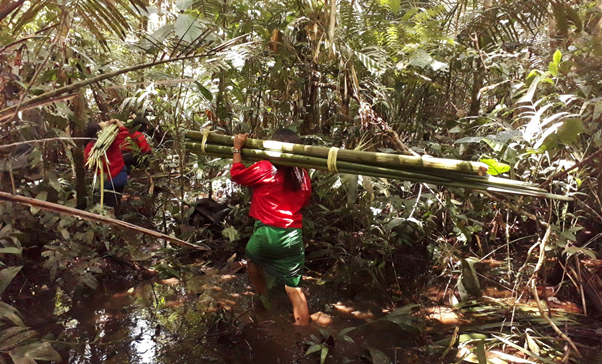
Indigenous Urarina women harvesting Mauritia flexuosa palm shoots from a peatland palm swamp in the Peruvian Amazon. Credit: Lydia Cole.

Researchers at the University of St Andrews and other members of the Tropical Wetlands Consortium, are measuring and mapping the distribution of carbon within the Peruvian Amazon peatlands, the biodiversity they contain and their long-term dynamics, to understand how they develop over centuries to thousands of years. Other projects, as many of the photographs highlight, are exploring the value, meaning and cultural importance of the peatlands to the communities who live there. The photographs in the exhibition have been selected to provide an insight into not only these peatland ecosystems and the people who live in and around them, but also the experience of doing research in these carbon-rich environments. You can find out more about the different projects and team members at www.tropicalwetlands.wp.st-andrews.ac.uk.

If you do have a look at the exhibition and it leaves you with questions or comments, the curators would love to hear them. Please email Lydia Cole (lesc1@st-andrews.ac.uk) if you have any feedback.

The future of Southeast Asia’s tropical peatlands

Nine years, five jobs, four cities and three paper rejections….and I’ve finally got the ultimate chapter of my PhD published. It’s been a journey! There’s so much I could write here about haphazard directions, happenstance, failure, resilience, the importance of ice-cream, etc., but I won’t. I hope there’ll be time for any helpful reflections in non-Zoom person soon. For now, here is the article: The future of Southeast Asia’s tropical peatlands: Local and global perspectives, free to download for the next 50 days (thanks for the token, Elsevier). And thanks to all of those people, both acknowledged in it and not, who have been ‘there’ over the last nine+ years.

The “graphical abstract“.

And paper’s “highlights”:

  • People have occupied Sarawak’s coastal peatlands for c. 200 years.
  • In the last century deforestation & peatland conversion have been widespread.
  • Local stakeholders perceive few challenges & many opportunities in using peatlands.
  • This conflicts with the international community promoting peatland conservation.
  • Differences in knowledge between local & global communities need to be addressed.

If any one of you out there reading do actually read this overly wordy piece and have feedback to share, I would love to hear it.

Talking transdisciplinarity

Last December (2020), Alex Chausson and I ran a workshop at the British Ecological Society’s virtual Festival of Ecology. After running a workshop the previous year on interdisciplinarity, this seemed like a natural next step. I learnt a huge amount from the process, not least about how to increase the likelihood of “having impact” through research. Here is a short post Alex and I put together for the IIED blog, to share our key learnings from the event.

A word cloud from the event, demonstrating which words sprung to mind for participants at the end of the workshop when they thought about “transdisciplinarity”.

Tools of the interdisciplinary trade – the write-up!